How to Get Someone Into Rehab When the First Answer Is No
Last updated
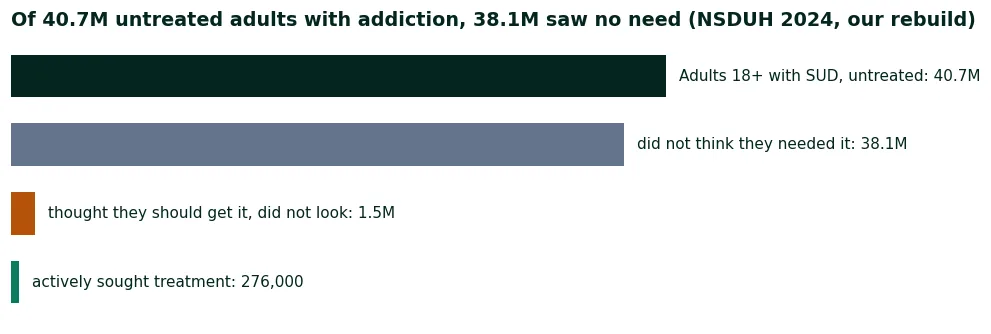
Start with the number that reframes everything: of the 40.7 million American adults who had a substance use disorder in 2024 and received no treatment, 95.6% did not think they needed it. The refusal you are facing is not your family failing; it is the statistically normal case, and the plan on this page is built around it. Expect the first answer to be no. Arrange the placement before you say a word, choose a sober and calm hour, describe what you have seen rather than what they are, and make one offer concrete enough to act on today. Forcing an adult is legally possible in most of the country, but it does not change the underlying math, and the evidence points somewhere else entirely: approaches that train the family engage roughly two to six times more people than staged confrontation.
The short version
- The refusal is the national norm — 95.6% of untreated adults with a substance use disorder saw no need for treatment in the 2024 national survey: 38.1 million of 40.7 million
- The active seeker is rare — about 1 in 147 untreated adults sought treatment last year; waiting for your person to call a facility on their own is a plan that almost never fires
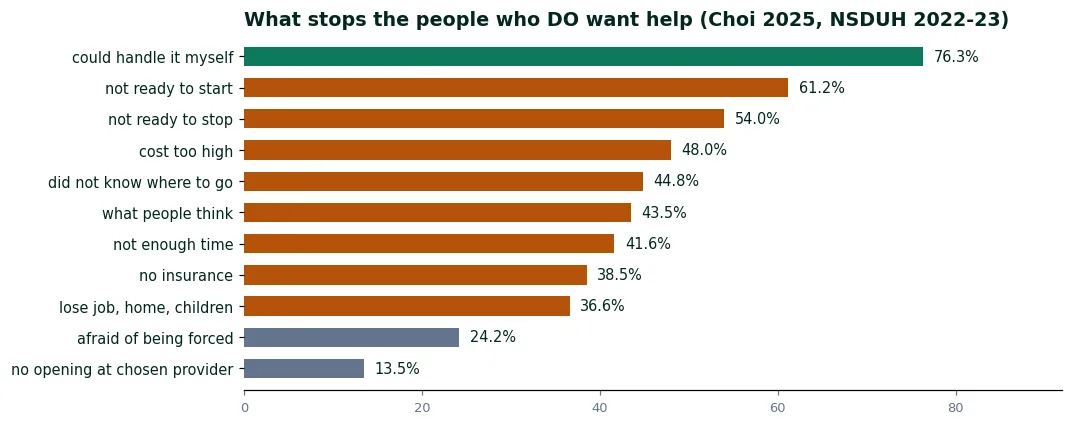
- The top barrier is not money — among those who wanted help but did not get it, 76.3% believed they could handle it alone; cost was fourth, at 48.0%
- Forcing is legal in most states — 34 states plus DC allow commitment where addiction alone qualifies, but a court order does not create willingness, and willingness is what treatment runs on
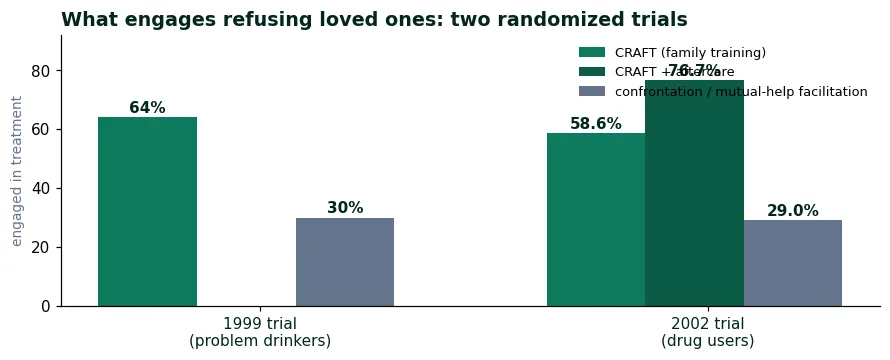
- Family training beats confrontation — in the randomized trials, CRAFT engaged 64% and 58.6-76.7% of refusing drinkers and drug users; staged interventions engaged 30% and 29%
- A yes expires quickly — willingness is a window measured in hours or days; the admission has to be ready before the word is spoken
Step by step
Plan for the no before you plan the talk
The national numbers say the first answer is almost always refusal, and that this says nothing about your family. Treat the first conversation as the opening of a campaign, not a verdict: the goal of round one is to plant a specific, workable offer, not to win.
Arrange the placement first
Before any conversation, call the facility or program and confirm a bed or an assessment date, verify what your insurance or funding route covers, and ask what admission requires and what condition they can accept someone in. When a yes comes, it has to be usable the same day.
Pick the hour deliberately
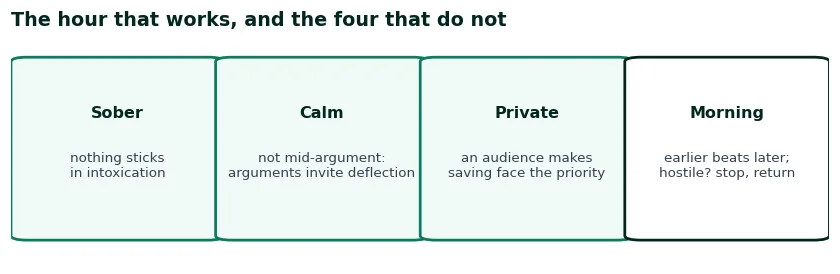
Sober, calm, private, earlier in the day rather than later. Not during intoxication, not mid-argument, not in front of an audience. If the moment turns hostile, stopping and returning later costs less than pushing through it.
Describe events, not labels
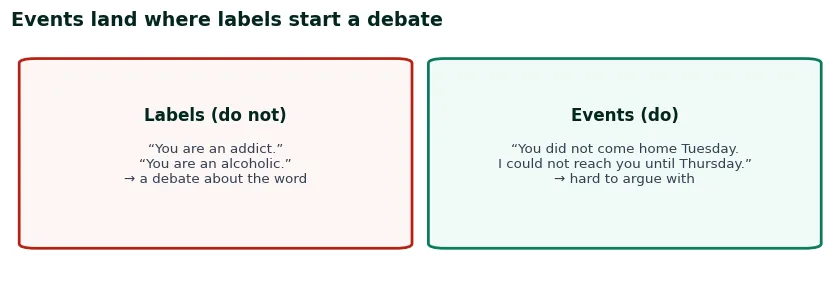
"You did not come home Tuesday and I could not reach you until Thursday" lands where "you are an addict" does not. A label invites a debate about the label. A dated, specific event is hard to argue with and keeps the conversation on what is actually happening.
Make one concrete offer
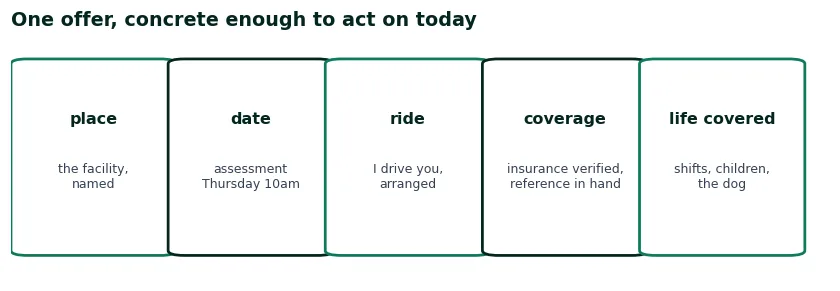
Not "please get help" but the place, the date, the ride, the insurance already checked, the children or the dog already covered. Vague encouragement is easy to postpone; a specific plan is harder to refuse and much easier to accept.
Answer the no with a boundary you control
A boundary is something you do, not something you demand: "I will not give money" is in your power. Announce only what you will actually enforce, keep the door and the arrangement open, and expect to ask more than once. That is what the research shows working.
The refusal your family is facing, measured nationally
Our analysisNobody publishes the odds of a no, so we rebuilt them from the federal survey on 14 October 2026. The point is not statistics for their own sake: it is that your family's situation is the normal one, and the plan has to be built for it.
- 95.6%
- of untreated adults with SUD saw no need for treatment
- 38.1 million of 40.7 million, NSDUH 2024; the refusal is the norm
- 87.7%
- of people 12+ with SUD got no treatment at all
- 42.4 million of 48.4 million
- 1 in 147
- untreated adults actively sought treatment
- 276,000 seekers among 40.7 million; do not wait for their call
- 76.3%
- of the willing-but-stuck believed they could handle it alone
- the top barrier in Choi 2025; cost was fourth at 48.0%
- 24.2%
- cited fear of being forced as a reason to avoid help
- why leading with commitment threats backfires
- 11.3%
- of young adults 18-25 who needed treatment got it
- the hardest age band to place; plan accordingly
How we got this: we read the 2024 National Survey on Drug Use and Health (SAMHSA report rpt56287) on 14 October 2026 and recomputed its treatment funnel from the family side: Figures 35, 69, 71 and 73, Tables A.52AB and A.55AB, with ratios recalculated per 100 untreated adults.
What these numbers cannot tell you: the survey measures self-reported need and treatment receipt across households; it cannot say whether your person will accept help, only how the national pattern runs.
The refusal is the normal case, and the numbers prove it
Families usually arrive here carrying two beliefs: that their person's refusal is extraordinary, and that their own failure to break it is a family defect. The national survey says otherwise. We pulled the 2024 National Survey on Drug Use and Health, the federal government's primary household measurement, and rebuilt its treatment funnel from the family's point of view. What it shows is that refusal is the mass behavior, and seeking is the rare exception.
| Layer of the funnel | People |
|---|---|
| People 12+ with a past-year substance use disorder | 48.4 million |
| ... who received no treatment for it | 42.4 million (87.7%) |
| Untreated adults 18+ with a substance use disorder | 40.7 million |
| ... of them: did not think they needed treatment | 38.1 million (95.6%) |
| ... thought they should get it but did not look | 1.5 million (3.8%) |
| ... actively sought treatment | 276,000 (0.7%) |
People 12+ with a past-year substance use disorder
48.4 million
... who received no treatment for it
42.4 million (87.7%)
Untreated adults 18+ with a substance use disorder
40.7 million
... of them: did not think they needed treatment
38.1 million (95.6%)
... thought they should get it but did not look
1.5 million (3.8%)
... actively sought treatment
276,000 (0.7%)
The odds your person has already said no
Out of every 100 untreated adults with a substance use disorder, about 96 do not believe they need treatment. If your loved one, your son, daughter, partner or parent, has refused, they are behaving like the overwhelming majority of people with the condition. That is not comforting, but it is useful: it means the task is not to find the magic sentence that fixes an unusual person, but to work a process designed for a reluctant one.
The seeker is rare, and that is the whole point
Among untreated adults, roughly one in 147 actually sought treatment last year. The people who call a program on their own exist, but they are statistical rounding. Waiting for your person to hit bottom, wake up motivated and dial a facility is a plan built on the rarest outcome in the national data. The workable plan assumes you, not they, will do the arranging.
Why this page starts here
Every step that follows assumes reluctance rather than willingness: the placement arranged in advance, the moment chosen, the offer made concrete. Pages that skip this assumption give advice that works beautifully on people who already want help, which is to say on 4.4% of the people you are likely to be dealing with.
What stops the people who do want help
The small minority who see the problem and still do not get treatment have been asked why, in the pooled 2022-2023 survey data analyzed by Choi and colleagues in 2025. Their answers matter to you twice: once because they show what the word "no" is actually made of, and once because several of the barriers are things a family can remove before the conversation.
| Reason reported | Share citing it |
|---|---|
| "I could handle it myself" | 76.3% |
| Not ready to start treatment | 61.2% |
| Not ready to stop or cut use | 54.0% |
| The cost was too high | 48.0% |
| Did not know where to go | 44.8% |
| Worried what people would think | 43.5% |
| Not enough time | 41.6% |
| No health insurance | 38.5% |
| Would lose job, home or children | 36.6% |
| Afraid of being forced against their will | 24.2% |
| No opening at the provider they wanted | 13.5% |
"I could handle it myself"
76.3%
Not ready to start treatment
61.2%
Not ready to stop or cut use
54.0%
The cost was too high
48.0%
Did not know where to go
44.8%
Worried what people would think
43.5%
Not enough time
41.6%
No health insurance
38.5%
Would lose job, home or children
36.6%
Afraid of being forced against their will
24.2%
No opening at the provider they wanted
13.5%
The biggest competitor is not the price
The single largest barrier, cited by three quarters of willing non-starters, is the belief that the problem can be handled alone. Families spend their energy preparing arguments about consequences; the wall they hit is usually self-sufficiency, and it yields to different tools: small steps framed as strength, outpatient starts that do not require surrendering a life, and offers that leave the person some control.
Logistics hide behind the refusal
Not knowing where to go (44.8%), no insurance (38.5%), no time (41.6%) and fear of losing a job, home or children (36.6%) are all problems a second person can solve or soften. This is the family's homework list. Every one of these you settle in advance removes one respectable reason to say no, and what remains is the real conversation.
Fear of force is a real barrier
A quarter of the willing-but-stuck, 24.2%, cited fear of being forced into treatment against their will. Families who open with threats of commitment or ultimatums are feeding a documented reason people avoid help. Leading with choice is not softness; it is what the barrier data says works.
Get the placement ready before the conversation
The most common way these campaigns fail is a yes that expires in a waiting list. Willingness arrives in a window and closes, and if admission is three phone calls and two weeks away, the window closes first. The arrangement work is unglamorous and it is the whole game.
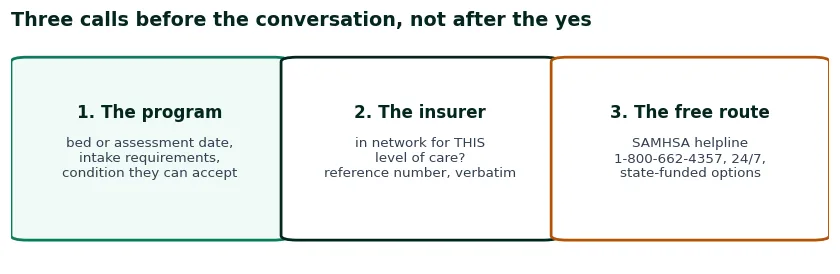
The three calls that decide the same-day yes
First, the program itself: is there a bed or an assessment slot, what does intake require, and in what condition can they accept someone, since some require sobriety or medical clearance. Second, the insurance member-services line: is this facility in network for this level of care, because a refusal at the door on coverage grounds is the most common same-day failure. Third, if money is unclear, the free route: the SAMHSA National Helpline at 1-800-662-4357 is staffed around the clock and refers to local options, including state-funded ones, and FindTreatment.gov is the public locator.
Outpatient is the fast lane
Residential beds are the scarce resource; outpatient and intensive outpatient programs start sooner and keep jobs and households intact. Where the wait for a bed is the obstacle, an assessment and an outpatient start this week, with residential still being arranged, beats a perfect plan that lands next month. The levels and how they differ are laid out in PHP vs IOP and detox vs rehab.
What to write down
Names, dates, reference numbers, the exact phrase the insurer used about coverage, the intake requirements verbatim, and the bag that would need to be packed. In the window of a yes you will not reconstruct any of this from memory, and the difference between families who convert a yes and families who lose it is usually paperwork, not persuasion.
The conversation itself
With the placement ready, the conversation is about delivery. None of this is theatrical. The research on engagement and the barrier data point the same way: calm, specific, respectful, and short beats dramatic, general and long.
The hour that works
Choose a moment when the person is sober and the room is calm, earlier in the day, in private. Not during intoxication, when nothing sticks; not during a fight, when everything is deflection; not in front of an audience, where saving face becomes the priority. If it turns hostile, stop. A postponed conversation is a cost; a blown-up one is a setback.
Events, not labels
Describe what you have seen, with dates: the missed pickup, the call that did not come, the morning after. Labels such as addict or alcoholic invite an argument about the word, and the argument about the word is a way to never discuss the thing. Specific events are hard to dispute, and they keep the conversation on behavior, which is the only ground where agreement is possible.
One offer, concrete enough to act on today
The offer is the facility, the date, the ride, the coverage already verified, the obligations already covered. "There is an assessment on Thursday at ten, I will drive you, your shifts are covered, the dog is handled" is an offer a person can say yes to. "You need to get help" is a sentence they have already survived a hundred times.
If the answer is no
It will be, the first time, in most families. Do not escalate inside the conversation. Acknowledge it, keep the offer open, and return another day. Ambivalence is a feature of the condition, not a verdict on you; the person who refuses on Tuesday is often the person who accepts in three weeks, but only if Tuesday did not end in scorched earth.
Can you make an adult go? The law, honestly
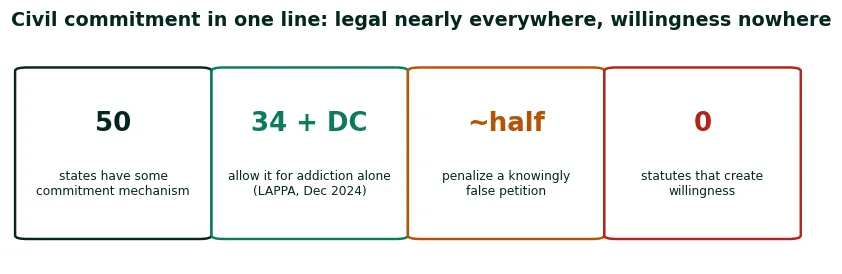
Every state has some civil commitment mechanism, and in most of the country addiction can trigger it. The Legislative Analysis and Public Policy Association's December 2024 summary counts 34 states plus DC where a substance use disorder alone satisfies the criteria; in most of the rest, a co-occurring mental illness must also be present. Who may petition is usually a spouse, guardian, relative or provider, the standard of proof is high, and roughly half the states penalize a knowingly false petition, a few as a felony. This is real law with real teeth, and court-ordered rehab walks through the process. The question families actually need answered is not whether it can be done but what it buys.
Does forced rehab work?
The honest answer is narrower than either camp claims. NIDA's principles state that treatment does not need to be voluntary to be effective, and legally mandated treatment can keep people engaged long enough for recovery to begin. What no statute can do is change the arithmetic you saw above: commitment does not install a sense of need. Families filing for commitment should treat it as buying time and a door, not as the cure, and should know there is no official "success rate" for forced rehab; anyone quoting you one is inventing precision the literature does not contain.
What the barrier data says about leading with threats
Remember that 24.2% of willing non-starters cited fear of being forced as a reason they avoided help. A family that opens with "we will have you committed" may close the voluntary door they actually want. Commitment is the emergency brake, for the situations where danger is immediate; it works least well as the opening move.
Can a rehab keep someone against their will?
Generally no. A voluntary patient can leave against medical advice, and facilities are not prisons; only a court order or a legal hold makes treatment involuntary. Some families discover this in the first week, when their person walks out. Knowing it in advance changes what you arrange: the plan after admission matters as much as the admission.
If you are considering this route
Read your own state's statute rather than a general article, because who can file, what must be shown and how long an order lasts all vary. The LAPPA summary is the starting map; your state's substance abuse agency can tell you what the process actually looks like locally. This page is not legal advice, and a lawyer in your state is the right expense if you go this way.
What families do that measurably works
The staged confrontation is the image everyone carries, and it has been tested against the alternatives in randomized trials. The results are specific enough to reorganize a family's whole approach, and they explain why staging an intervention on the television model is no longer the default recommendation.
CRAFT, in one paragraph
Community Reinforcement and Family Training teaches the family, not the patient: how to stop reinforcing use and start reinforcing non-use, how to communicate without triggering the defensive argument, how to recognize the windows when a person is receptive, and how to have the placement ready. In the Miller, Meyers and Tonigan trial, CRAFT engaged 64% of initially unmotivated problem drinkers in treatment. The Johnson Institute confrontation engaged 30%. Al-Anon facilitation engaged 13%. The famous approach came second; the one nobody has heard of won by a wide margin.
Replicated with drugs, not just alcohol
The follow-up trial with family members of treatment-refusing illicit drug users found the same shape: CRAFT alone engaged 58.6%, CRAFT with aftercare engaged 76.7%, and the mutual-help facilitation engaged 29.0%. Two details matter for expectations: engagement came after four to six sessions on average, not one evening, and no family engaged their person after their own sessions had ended. The work is the sessions, not the reading about them.
The finding about you, not them
Across all arms of these trials, the family member's own functioning and the relationship improved whether or not the person entered treatment. That is the most humane result in this literature and the least reported: the work is not wasted if they say no, because part of the benefit lands on you, and you will need it.
If you are thinking of hiring an interventionist
Know two things before paying a deposit. The title is not a licensed profession: certifications are voluntary, so ask what a specific person holds and who issued it. And some interventionists receive referral fees from the facilities they recommend, so ask directly whether any money flows from any facility, before you discuss where your person might go. A clean answer sounds like an answer; vagueness is also an answer.
Money, insurance, and how fast this can happen
Cost is the fourth barrier, not the first, but it is the one families can prepare most concretely. The short version: insurance usually covers some of this, free routes exist in every state, and the published price is frequently not the price people pay. The detailed numbers live on average cost of rehab; what follows is the sequence.
When there is insurance
Call member services with the facility's name and the level of care, and ask the direct question: is this covered, in network, and what is my share. Get a reference number. Parity law means substance use treatment is generally covered on the same terms as other medical care, but the details decide the bill, and the details are exactly what that call settles.
Without insurance, in the order to try
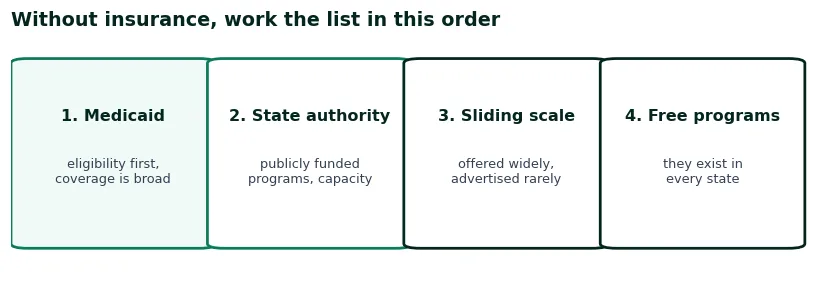
First Medicaid, since eligibility can be checked quickly and Medicaid coverage for rehab is broader than most families assume. Second, the state substance abuse authority, which administers publicly funded treatment and knows what has capacity. Third, sliding-scale fees, which many facilities offer but rarely advertise. Fourth, genuinely free programs, mapped on free drug rehab. The SAMHSA helpline, free and staffed 24 hours, can route you into any of these.
How fast is fast
An assessment can usually happen within days, outpatient starts within a week or two, and residential beds are where the waiting lists live. Detox, where it is medically needed, is its own track with its own timing, covered in does insurance cover detox. The honest answer to "how to get someone into rehab immediately" is: the paperwork can start today, the conversation is the part with no shortcut, and an outpatient start now beats a residential bed next month.
If they say no, and if they say yes
Both outcomes need a plan, and most families only prepare for one. The no is the statistically normal case; the yes is the fragile one.
Working the no
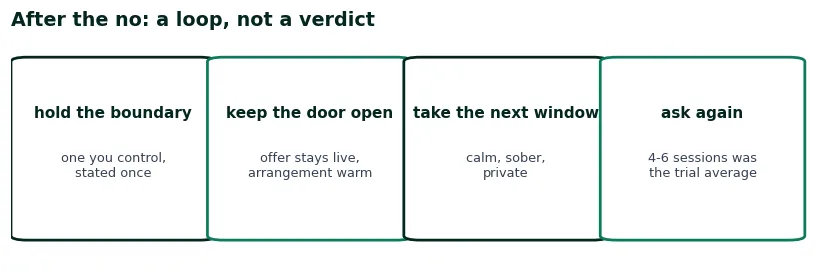
Set the boundary you actually control, state it once, and keep it. Keep the arrangement warm: the facility knows you may call back, the insurance answer is written down, the offer remains open. Then live your life in the open, without surveillance or interrogation, and take the next calm window when it comes. The trials found engagement after four to six sessions of deliberate work; there is no reason to expect your kitchen to be faster.
The same-day yes
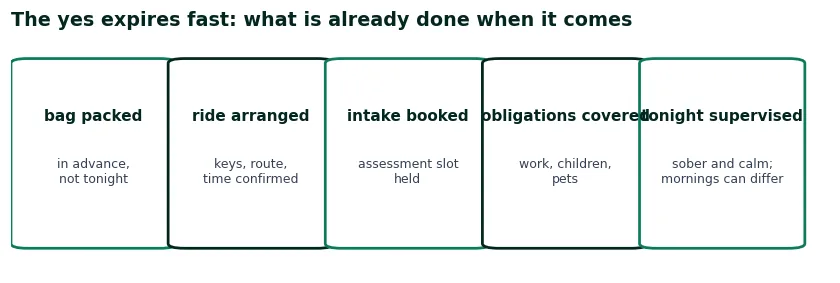
When the yes comes, move the same day. Have the bag packed in advance, the ride arranged, the intake time confirmed, and the obligations covered. The goal is to have them admitted before the window closes, not to schedule a family discussion about the yes. If the earliest admission is tomorrow morning, tonight is supervised, sober and calm, because the morning answer is sometimes different.
After admission, the family's job starts
Take part in the family sessions the program offers; they are associated with better retention and they are where you learn which of your own patterns fed the problem. Al-Anon, Nar-Anon and SMART Recovery Family & Friends exist because the strain on you is real and predictable. And know the rules of the place before visiting day: rehab rules covers what facilities typically allow, and what happens in rehab covers what your person's days will look like.
Special situations
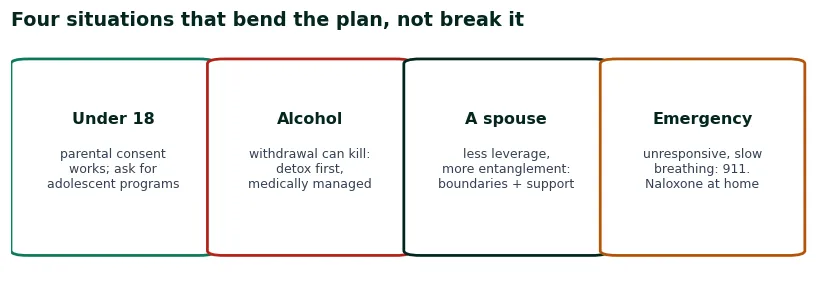
The general plan bends in four common cases. Each changes one part of the playbook, not the whole of it.
If they are under 18
A parent or guardian can generally consent to treatment for a minor, so the legal problem is smaller and the engagement problem is the same. Adolescents show the same refusal pattern as adults: in 2024, 93.3% of untreated 12- to 17-year-olds with a substance use disorder did not think they needed treatment. Ask specifically for adolescent programming, because adult programs are frequently not appropriate for them.
Alcohol specifically
Everything on this page applies, with one medical addition: alcohol withdrawal can kill. Do not arrange a sudden unsupervised stop for a heavy daily drinker; the route is detox first, medically managed, then treatment. The same is true for benzodiazepines. This is the one case where "stop today" is the wrong advice.
When it is your spouse
The trial data found engagement rates higher when the family member doing the work was a parent than a spouse, which matches what spouses report: the partner role carries less leverage and more shared-life entanglement. A spouse's version of this plan leans harder on boundaries you control and on your own support, and it is worth saying plainly that protecting children and finances is part of the plan, not a betrayal of it.
When it is an emergency, not a conversation
Unresponsiveness, slow or stopped breathing, blue lips, seizures, chest pain or confusion are 911, not a talk. If opioids are in the picture, keep naloxone in the house; it is available without a prescription and reverses an overdose in minutes. No plan on this page outranks a living person.
Where this sits in the system of care
Addiction treatment is organised into levels of care, and clinicians choose between them using the ASAM criteria (six dimensions covering withdrawal risk, medical and psychiatric conditions, readiness, relapse risk and, decisively, the environment you return to. Facilities are licensed by the state and many hold additional accreditation from bodies such as the Joint Commission or CARF; that status is worth confirming for any specific programme. Percentages below are our count of how many facilities in the federal directory report offering each level of care.
- Detox19.5% of facilitiesmedical withdrawal management, 3–7 daysDetox vs rehab
- Residential21.4% of facilitieslive on site, 24-hour staffingInpatient vs outpatient
- PHP20–30 structured hours a week, sleep at homePHP vs IOP
- IOP9–19 hours a week, usually compatible with workPHP vs IOP
- Standard outpatient85.4% of facilities1–8 hours a week, the maintenance levelMutual aid options
“Remaining in treatment for an adequate period of time is critical.”
Programmes for specific groups
Facilities also report dedicated programming, and the coverage is wider than most people expect, worth asking about before assuming a programme will not fit. From our count: 42.7% run programmes for adolescents, 39.2% for veterans, 38% for pregnant and postpartum women, and 25% provide services in Spanish. Medication for opioid use disorder is available at 59.2% (buprenorphine) and 13.7% (methadone).
Cost and coverage vary by level: residential care is the tier insurers scrutinise most and almost always requires prior authorisation before admission. See what your plan covers and how to pay without insurance. Family involvement is a standard part of most programmes, and aftercare planning ( step-down to a lower level, sober living, relapse prevention) should be discussed before admission, not at discharge. If a mental health condition is also present, ask specifically whether the programme is staffed for co-occurring disorders: 69.5% of facilities in the directory report treating them, but that is a self-reported field worth confirming.


Common questions
What if they say no?
Expect it the first time; 95.6% of untreated adults with a substance use disorder do not believe they need treatment, so refusal is the national norm and not the end. Keep the arrangement warm, hold only boundaries you control, and take the next calm window. The person who doesn't want to go today is often the one who accepts in three weeks; in the trials, engagement came after four to six sessions of deliberate family work, not one conversation.
Can you force someone into rehab?
For a minor, a parent or guardian can generally consent to treatment. For an adult, only through civil commitment: 34 states plus DC allow it where addiction alone meets the criteria, most of the rest require a co-occurring mental illness, the standard of proof is high, and false petitions carry penalties in about half the states. It is the emergency brake, not the plan.
Does forcing someone into rehab work?
It can open a door, and NIDA notes treatment does not need to be voluntary to be effective, but commitment does not create the willingness treatment runs on. There is no official forced-rehab success rate; anyone quoting one is inventing precision. The measured approaches that engage more people are the family-training ones.
How do I get someone into rehab without insurance?
In order: check Medicaid eligibility, call your state substance abuse authority about publicly funded programs, ask facilities about sliding-scale fees, and look at genuinely free programs. The SAMHSA National Helpline, 1-800-662-4357, is free, staffed around the clock, and refers into all of these routes.
How fast can someone get into rehab?
An assessment within days and an outpatient start within a week or two are realistic in most areas; residential beds are where waiting lists live. The paperwork can start today. The part with no shortcut is the person's yes, which is why the placement is arranged before the conversation.
What if they are under 18?
Parents or guardians can generally consent to treatment for a minor, so the legal problem is smaller, but engagement still matters: 93.3% of untreated adolescents with a substance use disorder saw no need for it in 2024. Ask specifically for adolescent programming, since adult programs are frequently inappropriate.
How do I convince an alcoholic to go to rehab?
The same plan, with one medical exception: heavy daily drinking can make unsupervised withdrawal dangerous, and detox comes first. For the conversation itself, the evidence favors calm, specific, event-based offers over confrontation, and family-training approaches over staged interventions.
Can a rehab center keep you against your will?
No. Voluntary patients can leave against medical advice, and facilities are not prisons; only a court order or legal hold makes treatment involuntary. Families should plan for this: the days after admission carry a real risk of walking out, which is why the follow-through plan matters as much as the admission.
Sources
- SAMHSA: Results from the 2024 National Survey on Drug Use and Health (rpt56287), our funnel rebuild of 14 Oct 2026: Figures 35, 69, 71, 73; Tables A.52AB, A.55AB
- Choi et al. 2025: Treatment use among US adults with a substance use disorder, NSDUH 2022-2023 pooled, the barrier percentages
- Liu et al. 2025, JAMA Network Open: a decade of treatment need and receipt, 5.7% perceived need, 2.7% perceived and sought
- NIDA: Principles of effective treatment, treatment does not need to be voluntary to be effective
- LAPPA: Involuntary commitment for substance use disorders, summary of state laws, December 2024
- Miller, Meyers & Tonigan 1999: engaging the unmotivated in treatment for alcohol problems (CRAFT 64% / Johnson 30% / Al-Anon 13%)
- Meyers, Miller, Smith & Tonigan 2002: engaging treatment-refusing illicit drug users (CRAFT 58.6-76.7% / facilitation 29.0%)
- SAMHSA National Helpline: 1-800-662-4357, free, confidential, 24/7
- FindTreatment.gov: the public treatment locator
Compare levels of care
Check what your plan covers
How this page was made
- Who wrote it:
- the Westbrook Recovery editorial team : researchers and writers, not clinicians. No doctor has reviewed this page, and we do not claim otherwise. What that means in practice: we report what public clinical sources say and show you where to read them, rather than offering a clinical opinion of our own.
- Checked against:
- 9 primary sources listed above: federal agency material and published clinical criteria. Where a figure varies by state, plan or facility, we say so instead of publishing a number that looks authoritative and is not.
- Original analysis:
- the facility proportions on this page are our own count of SAMHSA’s public directory. The full method is documented , including what we count, what we deliberately do not publish, and an error the approach caught. You can repeat the pull and check the numbers.
- Last reviewed:
- . This date changes when the content is actually re-checked, not automatically on every visit.
- What this page is not:
- a medical recommendation, a diagnosis, or a referral. Decisions about levels of care and medication belong with a clinician who knows your history. We do not operate facilities, take placement fees, or receive payment for sending anyone anywhere.
Related on this site
- Court-ordered rehabthe legal route, state by state, when it is truly the emergency brake
- How to stage an interventionif you go the formal route, here is how to do it without the television script
- What happens in rehabwhat your person's days will actually look like after the yes
- Average cost of rehabthe money side, in detail, with the routes that cut it
More guides
- Free Rehab for VeteransVeterans get free addiction treatment three ways: VA care, Vet Centers without enrollment, COMPACT Act crisis care. How each door works.
- Average Cost of RehabWe read the top-ranking pages and their quoted 30-day prices disagree by 11x. Real cost drivers by level of care, and how to get your actual number.
- Addiction Treatment for Pregnant WomenTreatment in pregnancy is safer than untreated addiction: recommended medications, supervised detox, integrated prenatal care, priority rules.
- Rehab for Women With ChildrenRehab when you have children: programs where kids stay, childcare during treatment, custody, and funded routes for mothers.
- Does Medicaid Cover Drug Rehab?Yes, in every state, but the details differ by state. What Medicaid covers at each level, the IMD wrinkle, and our per-state counts.
- Rehab That Allows Cell PhonesWhich rehabs allow cell phones: the spectrum from lockbox to open access, who allows what, and how to verify a policy in writing first.
- Alcohol Rehab for SeniorsAlcohol treatment for older adults: slower, safer detox, medication and fall risks, what Medicare covers, and finding a program that fits.
- Long-Term Drug RehabLong-term rehab is 90 days to a year: therapeutic communities, extended care, ministry programs. Who needs it, what it costs, the research, vetting.
- How to Stage an InterventionHow to stage an intervention that ends in treatment: the team, the letters, rehearsal, the bed arranged first, and what to do if the answer is no.
- Drug Rehab for CouplesCan couples go to rehab together? The two models, the approach with real trial evidence, costs for two, and how to vet a program.
- Executive Drug RehabExecutive and luxury rehab: what the premium buys, what insurance covers, privacy under 42 CFR Part 2, and how to verify clinical quality behind amenities.
- Does Insurance Cover Detox?Yes, almost always: detox is the most defensible level of care to insurers. Prior auth, Medicaid and Medicare rules, and what our audit of 5 insurers found.
- Free Drug RehabFree addiction treatment exists: state-funded programs, Medicaid, sliding scales and charity. What free covers and how to find real care near you.
- Christian Drug RehabChristian drug rehab: licensed programs with a faith track versus ministries, what treatment includes, costs, and how to verify a program before enrolling.
- How Long Is Rehab?Detox takes 3 to 7 days, residential rehab 30 to 90 days, outpatient care 8 to 12 weeks. What decides your stay, measured against 10,233 facilities.
- How to Pay for Rehab Without Insurance: Which Door Your Income OpensNo insurance does not mean no treatment. The 2026 income lines in dollars: Medicaid, the subsidy cliff, state-funded care, sliding scales.
- Rehab Rules in 2026: What Ten Real Handbooks Actually SayWe read ten real patient handbooks and counted: phones restricted at nine of ten, a 30-day blackout at one. What the rules say, and what to ask.
- Suboxone Withdrawal Timeline in 2026: What the Studies MeasuredHow long Suboxone withdrawal lasts, why it starts late, and what the taper trials measured: the timeline from evidence, not folklore.
- 7-OH Withdrawal Timeline: What the Record Shows, Not the ForumsWhat 7-hydroxymitragynine withdrawal looks like, what the 200 PubMed papers actually measure, and where the federal ban stood on 14 October 2026.
- Meth Withdrawal Timeline: The Shape, the Source, and What the Top Pages Get WrongWorst inside the first day, better across the week, a long low tail. We checked the top pages against the one study behind their numbers.
- Cocaine Withdrawal Timeline: The Crash, the Weeks After, and What HelpsWhat cocaine withdrawal feels like hour by hour and week by week, why no approved medicine exists after 166 trials, and the treatment 149 trials support.
- Opioid Withdrawal Timeline: The Clock, the Peak, and How It Is Actually MeasuredOnset about 12 hours after short-acting opioids, 30 after methadone; worst days two to three. Plus the scale clinicians use, read from the source.
- Relapse Warning Signs in 2026: The Signs and the Measured Map Behind ThemThe measured map behind relapse warning signs: what precedes relapse across three substances, from the 1985 table and its 2026 replication.
- Rehab for Professionals: The Monitored Path, MeasuredLicensed professionals are treated inside monitored programs with the field's best documented outcomes. Who runs them, with the FAA numbers.
- What Happens in Rehab: The Day, the Week, the MonthAdmission day is paperwork, not therapy. Most of the rest is group work. An honest account of the schedule, the therapies by name and the emotional arc.
- Court-Ordered Rehab: How It Works, What It Costs, Whether It WorksWhat court-ordered rehab actually means, how drug courts work phase by phase, what 337 studies and 4,000 courts show, and what happens if you fail.
- Sober Living Rules in 2026: The House Rules, and the Network Behind ThemThe house rules people actually live under, plus our own count of the largest network: every Oxford House in the live directory, by state, beds and openings.
- How Long Suboxone Stays in Your System: The Two Clocks, MeasuredBuprenorphine half-life 24-42 hours; urine finds it about a week after daily use, hair for months. What the label and 488 studies say.
Weighing levels of care? See PHP vs IOP and what your insurance covers.
This page is information, not medical or legal advice. Laws on commitment and treatment differ by state. If you are in crisis, call or text 988 in the US, or reach the SAMHSA National Helpline at 1-800-662-4357 — free, confidential, 24/7.