7-OH Withdrawal Timeline: What the Record Shows, Not the Forums
Last updated
Searched as often without the hyphen as with it, 7oh, the substance is the same: withdrawal from 7-OH follows the opioid pattern because 7-OH is an opioid in everything but the shop label: a mu-opioid receptor agonist that a 2025 Pharmaceutical Biology review describes as more potent than morphine in preclinical work. Expect the first symptoms within hours of the last dose, the hardest stretch across the first days, and a tail of poor sleep and low mood that can run for weeks. Two things most pages will not tell you: there has never been a measured 7-OH withdrawal timeline in a clinical study, so every hour-by-hour chart is borrowed from other opioids, and the entire peer-reviewed record on this substance is 200 papers, two of them randomised trials. We counted.
The short version
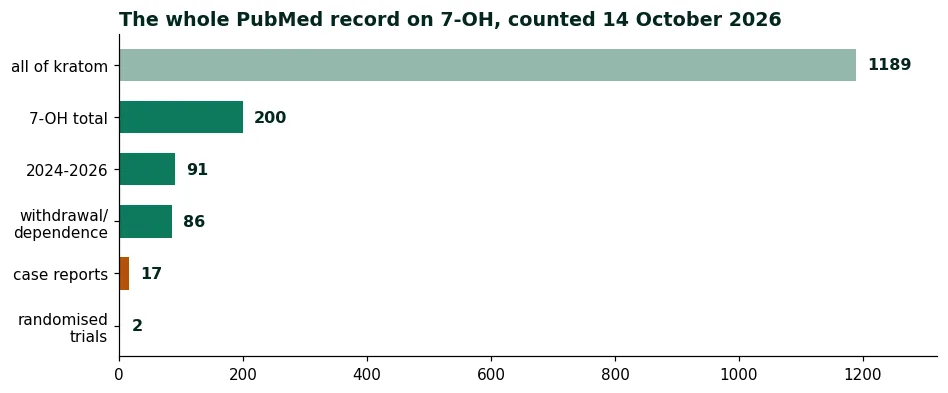
- The whole literature is 200 papers — our PubMed count, 14 October 2026: 200 publications on 7-hydroxymitragynine, 91 of them since 2024, only 2 randomised trials and 17 case reports
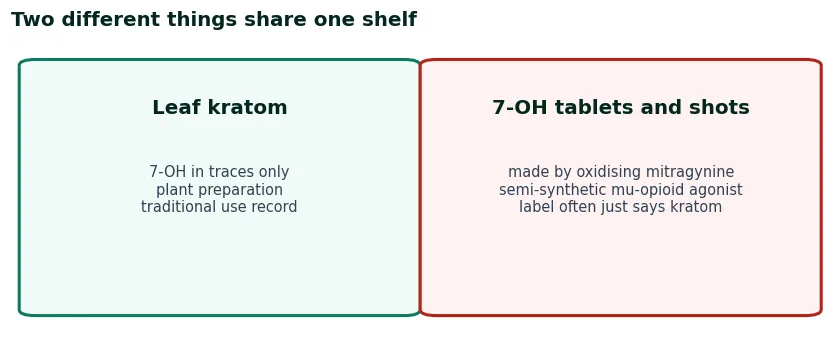
- Not the leaf in the bag — the leaf carries 7-OH in traces; the tablets and shots are made by oxidising mitragynine into something the plant barely contains
- Dependence can show in days — a 2025 Journal of Addiction Medicine case documents withdrawal after four days at 20 mg three times daily
- Buprenorphine has its first published success — a 2026 case in Primary Care Companion for CNS Disorders reports 7-OH withdrawal treated with buprenorphine-naloxone, the first such report in the record
- The ban moved again this month — the July notice was withdrawn and replaced by a new one published 14 October 2026; the three related compounds stay in Schedule I until August 2028
- You will not find it in the treatment directory by name — the federal locator has no category for kratom or 7-OH, so the route in is the opioid one
We counted the entire PubMed record on this substance
Our analysisEvery confident answer about 7-OH rests on a small pile of papers. We measured the pile on 14 October 2026, querying PubMed directly, because the gap between what is claimed online and what has been measured is the finding that disciplines everything else on this page.
- 200
- publications on 7-hydroxymitragynine, total
- PubMed esearch, 14 October 2026; query verbatim in sources
- 91
- of them published in 2024-2026
- nearly half the record is three years old or newer; measurement is chasing the market
- 2
- randomised controlled trials
- the entire trial record; everything else is pharmacology, surveys and case reports
- 17
- case reports
- including the 2025 dependence-in-four-days case and the 2026 buprenorphine-naloxone treatment case
- 86
- papers mentioning withdrawal or dependence
- the clinical problem is documented; its timeline is not
- 1,189
- papers on kratom, the parent plant
- six times the record of the compound now sold beside it
How we got this: we counted the 7-hydroxymitragynine literature directly on PubMed's public E-utilities on 14 October 2026; every slice of the record is printed verbatim in this page's record and reruns to the same count.
What these numbers cannot tell you: a thin literature count says how little has been measured, not what is safe; for this compound the clinical answers largely do not exist yet, which is itself the finding.
What is actually in the package
Start with the object, because the withdrawal only makes sense once the object is clear. 7-hydroxymitragynine is a genuine alkaloid of the kratom plant, and the body also converts some mitragynine into it after any kratom is swallowed. What it is not is a meaningful part of dried leaf: it occurs at trace levels there. The products sold as 7-OH, tablets, powders and liquid shots, are made by oxidising mitragynine, kratom’s main alkaloid, into a compound the plant never concentrates. The 2025 review in Pharmaceutical Biology calls these chemically distinct from botanical kratom preparations, which is the polite version of saying the bag says kratom and the contents say opioid.
Two products sharing one shelf
Leaf powder and a 7-OH tablet are routinely marketed as the same family, and they are not. One is a plant preparation with a long record of traditional use; the other is a semi-synthetic opioid agonist assembled in a lab step. If withdrawal caught you by surprise, the surprise was manufactured at the point of sale, not in your reading of the label.
Why the strength you took is anyone’s guess
These products are not dosed to a pharmaceutical standard, and the same brand can vary batch to batch. That matters later, when a taper plan or a clinician asks how much you were taking: the honest number is often unknowable, which is one reason self-built taper schedules go wrong.
What the science actually consists of
Every confident page on this subject rests on a surprisingly small pile of papers, and we think you should know the size of the pile. We queried PubMed directly on 14 October 2026 and counted what the record contains, because the gap between how much is written about 7-OH online and how little of it is measured is itself the finding.
| Slice of the record | Papers |
|---|---|
| All publications mentioning 7-hydroxymitragynine | 200 |
| Published 2024-2026 | 91 |
| Published 2020-2023 | 64 |
| Mentioning withdrawal or dependence | 86 |
| Case reports | 17 |
| Randomised controlled trials | 2 |
| For comparison: all of kratom | 1,189 |
All publications mentioning 7-hydroxymitragynine
200
Published 2024-2026
91
Published 2020-2023
64
Mentioning withdrawal or dependence
86
Case reports
17
Randomised controlled trials
2
For comparison: all of kratom
1,189
Nearly half of it is three years old or newer
91 of the 200 papers appeared between 2024 and now. The substance sold in shops for years is being measured in real time, and the measurement is running behind the marketing. When a page tells you exactly what week three of withdrawal feels like, it is not citing one of the 200.
Two randomised trials is the whole trial record
Everything else is pharmacology in animals, chemistry, surveys and 17 case reports. Case reports are how a new clinical problem first becomes visible, and they are also all there is. A clinician working from evidence here is working from single cases, including the two we describe on this page.
Why we put the count on the page
Because it disciplines everything else we say. Where the record is thin we mark it as thin rather than padding around it. The timeline section below is the opioid pattern applied to a short-acting agonist, and it is labelled that way precisely because the measured version does not exist.
Why withdrawal behaves like an opioid’s
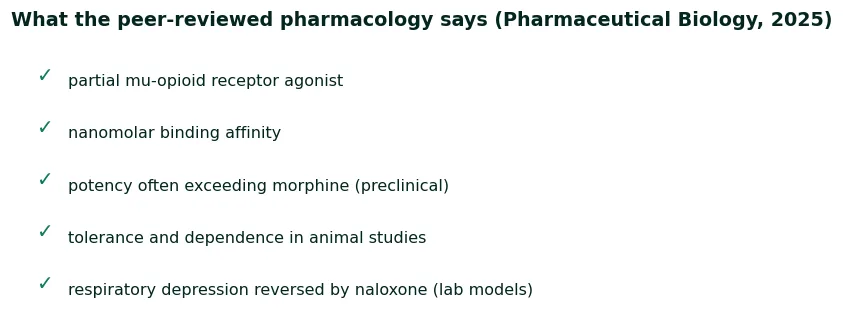
What does 7oh do that makes stopping hard? It acts like a short half-life opioid: concentrations fall fast, which is why the inter-dose troughs arrive within hours. The common 7oh side effects beyond dependence, sedation, nausea, constipation, are the opioid-family ones. The pharmacology is the least contested part of the story. The federal research institute notes that mitragynine and 7-OH both act at mu-opioid receptors, and the 2025 review is blunter on 7-OH specifically: a partial mu-opioid agonist with nanomolar affinity, greater efficacy than mitragynine, and potency that in preclinical models often exceeds morphine. Animal work shows the full opioid signature: pain relief, tolerance, dependence, reinforcement, and respiratory depression that naloxone reverses.
Stronger than morphine is a laboratory statement
It comes from binding and potency assays, not from a conversion table. There is no defensible milligram equivalence between a 7-OH tablet and morphine or oxycodone, because the answer depends on the product and the person, and nobody has run the study. Any site offering you that table is inventing it.
Dependence measured in days, not months
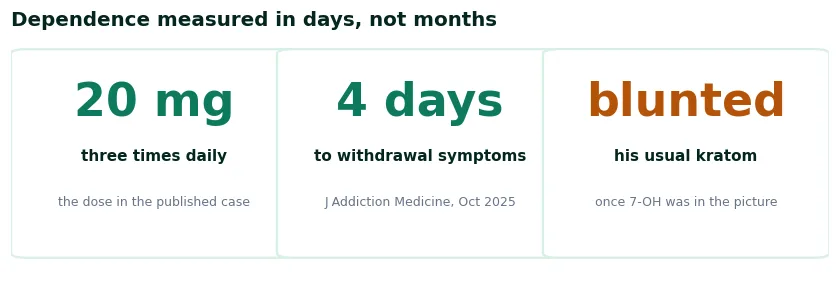
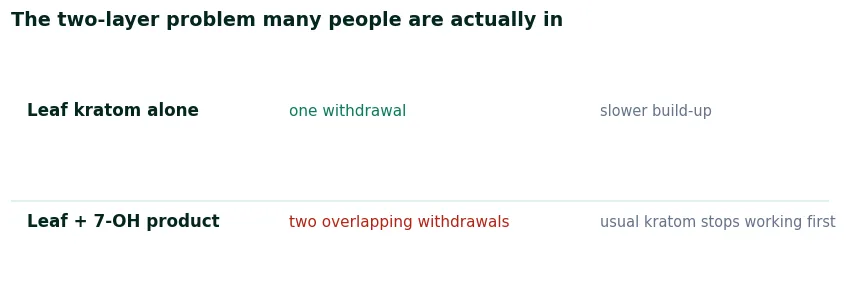
The 2025 case in the Journal of Addiction Medicine is instructive precisely because it is unremarkable in form: a long-term kratom user added a semi-synthetic 7-OH product at 20 mg three times a day and reported withdrawal symptoms after four days, with his usual kratom suddenly blunted. Four days is not a supplement habit forming. It is an opioid taking hold.
The route you take changes the grip
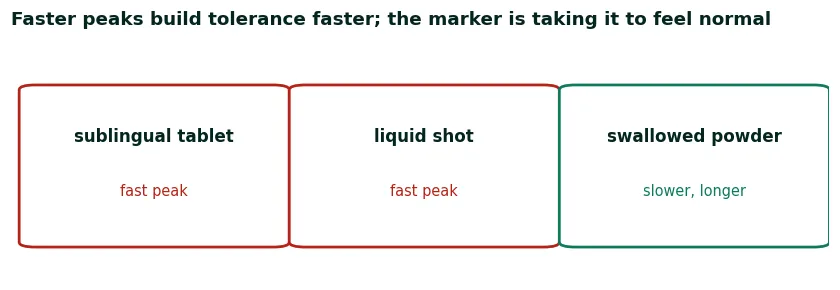
Sublingual tablets, swallowed powder and liquid shots produce different curves, and faster, sharper peaks build tolerance faster and make the troughs between doses feel worse. The practical marker is not the route but the reason for the next dose: taking it to feel normal rather than to feel anything is the line where dependence has already formed.
The timeline question, answered honestly
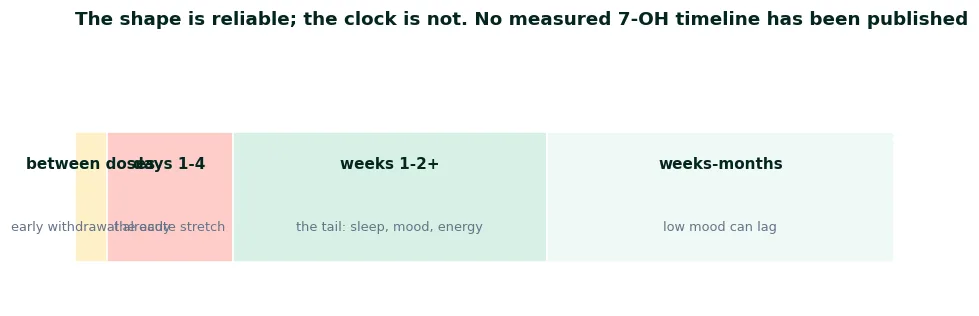
Here is the frame before any days or weeks. No measured timeline exists for 7-OH withdrawal: nobody has followed a cohort through it and published the curve. What exists is opioid withdrawal as a well-described syndrome and the certainty that 7-OH is a short-acting mu-opioid agonist. So the shape below is the opioid shape applied to this pharmacology, and it should be read as a pattern, not a timetable.
Onset: hours, not days
With a short-acting agonist the first symptoms generally arrive within hours of the last dose, and people dosing several times a day are often already in early withdrawal between doses. That inter-dose withdrawal is one reason the interval between doses tends to shrink over time. It is the opposite of a long half-life drug like buprenorphine, where onset can wait days, and anyone transferring expectations from one to the other gets caught.
The acute stretch is measured in days
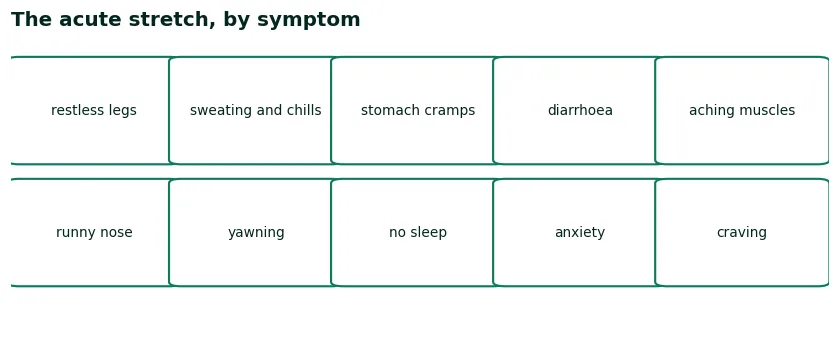
The first days carry the worst of it: restlessness, sweating and chills, stomach cramps and diarrhoea, aching muscles, a running nose, yawning, wide pupils, and sleep that will not come, with anxiety and craving underneath all of it. For short-acting opioids the acute phase is a matter of days, with intensity easing after the early peak.
The tail is measured in weeks
Sleep, mood and energy lag behind the body, and this stretch is where people most often conclude that stopping did not work, precisely when it is working. The weeks after the acute phase are where the warning signs of relapse are actually useful, not the first hard days.
Why this page prints no hour-by-hour chart
Because the measurement that would justify one has not been made, and the charts in circulation are general opioid withdrawal relabelled for this substance. We would rather you knew the shape is reliable and the clock is not.
The case that changed the buprenorphine answer
How addictive is 7oh? Dependence forming inside four days in the published case is the clinical answer. Until recently the honest answer on medication was that no published case showed it working. That changed in 2026, and pages written earlier have not caught up, including the previous edition of this one. It is the single most important update on this page.
What the new report documents
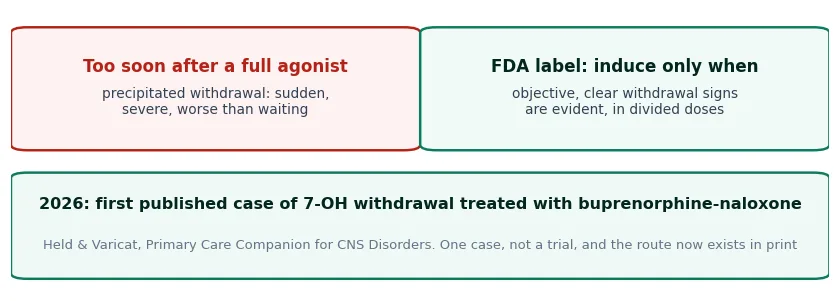
Held and Varicat, writing in Primary Care Companion for CNS Disorders in 2026, report a case of 7-hydroxymitragynine withdrawal treated with buprenorphine-naloxone. One case is not a trial, and we will not pretend otherwise, but it is the first published account of the obvious pharmacological idea working in practice: a partial agonist with high receptor affinity, given to a person dependent on a mu-opioid agonist, doing what it does in opioid use disorder.
The caveat that still stands
The federal research institute continues to state that no medical therapy is approved for kratom-related withdrawal and that robust trials are needed. A single case report does not change the approval status of anything. What it changes is the conversation you can have with a prescriber, which is now a conversation about a published case rather than a theory.
Timing is where it goes wrong
Buprenorphine started too early after a full agonist can trigger precipitated withdrawal, sudden and severe rather than gradual. The FDA label for buprenorphine-naloxone instructs induction only when objective and clear signs of withdrawal are evident, in divided doses. That instruction exists because the mistimed version is much worse than waiting, and it is covered in detail on our Suboxone withdrawal timeline.
Tapering down versus stopping outright
People search for how to quit 7-OH, and the first honest answer is that tapering and stopping cold are different events. For opioid-type dependence, gradual reduction is generally easier to tolerate and lowers the chance of the outcome that matters most: returning to use at a dose your reduced tolerance no longer handles. The specific difficulty here is that the products are not dosed for tapering and their content is unreliable, so a plan built on tablet fractions rests on an assumption about what is in the tablet.
What we still will not publish
A milligram-by-milligram schedule, and the reason is not legal caution. The right pace depends on how much, how long, what else is in the picture and how previous attempts went, none of which a web page can know. A schedule that looks authoritative invites you to follow it instead of someone who can ask you those questions.
What to arrange before day one
Someone who knows what you are doing. Fluids and simple food within reach. Naloxone in the house. Permission to slow the taper without treating it as failure. And a decision made in advance about what would make you call for help, because the judgement about whether things are bad enough is exactly what the worst days impair.
Does 7-OH show up on a drug test
Usually not on a standard panel, which surprises people in both directions. Routine workplace screens look for a defined list that does not include kratom alkaloids. Specific assays for mitragynine and its metabolites exist and are used in clinical and forensic settings, so the accurate statement is that it is not normally tested for, not that it cannot be found. Detection windows are a different question from withdrawal; the way Suboxone’s detection window is measured shows how the two questions get confused and why they should not be.
The legal record, as of this week
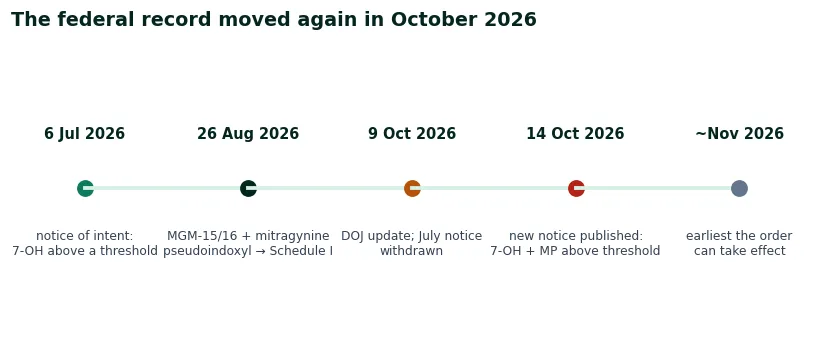
This is the section where most pages are stale, because they are written from news coverage rather than the register itself, and because the record moved again in the second week of October 2026. We read the Federal Register documents. Here is where it actually stands on 14 October 2026.
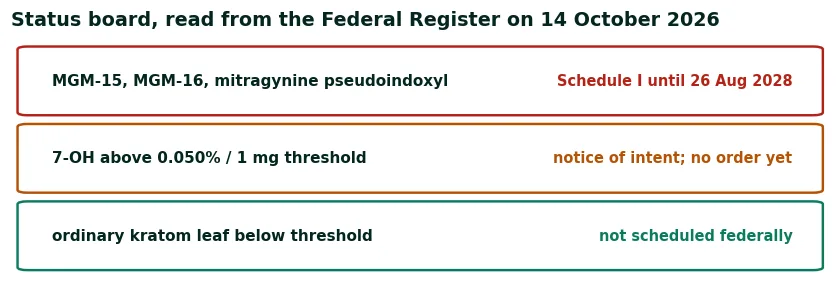
| What | Status today |
|---|---|
| Mitragynine pseudoindoxyl, MGM-15, MGM-16 | Schedule I, temporary order of 26 August 2026, in force until 26 August 2028 |
| 7-OH: July notice of intent (6 July 2026) | Withdrawn. The DOJ announced the update on 9 October 2026 |
| 7-OH and mitragynine pseudoindoxyl above a threshold | New notice of intent published 14 October 2026 (document 2026-20943); earliest order no sooner than about 30 days after publication |
| Ordinary kratom leaf below the threshold | Not scheduled by these actions; state law still applies |
Mitragynine pseudoindoxyl, MGM-15, MGM-16
Schedule I, temporary order of 26 August 2026, in force until 26 August 2028
7-OH: July notice of intent (6 July 2026)
Withdrawn. The DOJ announced the update on 9 October 2026
7-OH and mitragynine pseudoindoxyl above a threshold
New notice of intent published 14 October 2026 (document 2026-20943); earliest order no sooner than about 30 days after publication
Ordinary kratom leaf below the threshold
Not scheduled by these actions; state law still applies
What changed in October
The July notice proposed scheduling 7-OH above a specified threshold. On 9 October 2026 the Justice Department announced updates to the emergency scheduling actions, and the July notice was withdrawn and replaced with a new notice that adds mitragynine pseudoindoxyl above a threshold alongside 7-OH. A notice of intent is not a ban: the actual temporary order cannot take effect before roughly mid-November 2026, and the 2016 precedent, when a similar notice was withdrawn entirely, is the reason to hold this loosely.
The numbers that decide what is covered
The threshold definition on the table comes from the health department: botanical kratom material is in scope above 0.050 percent 7-OH by dry weight, and processed or synthetic articles are in scope above 0.050 percent by weight or above 1 milligram per article. That mechanism is aimed at concentrated products and is written to leave ordinary leaf below the line, which is the whole reason the threshold is being argued over in public.
States are not waiting
Rhode Island’s Kratom Act already names 7-hydroxymitragynine in statute, and county-level rules, Dutchess County’s 2026 local law among them, are appearing on their own timetables. Because the federal line is still moving and state statutes often name kratom but not 7-OH, check your state legislature’s own bill tracker rather than a vendor’s legality map, and check the date on whatever you find.
MGM-15 and MGM-16 are already controlled
The August order placed mitragynine pseudoindoxyl, MGM-15 and MGM-16 in Schedule I on an imminent-hazard finding, covering their isomers, esters, ethers and salts. These are distinct compounds, not other names for 7-OH, and a product listing one of them is already in Schedule I territory regardless of what happens to the new notice.
Where to actually get help
People typing 7oh withdrawal help into a search box are asking where to go. The federal treatment locator has no category for kratom or 7-OH, so there is no vocabulary to search it with, and the practical route in is the opioid one. That translation is pharmacologically correct, and nobody tells you to make it: the system that can help you sees opioid use disorder, and 7-OH dependence is one in everything but name. The page on what happens in rehab describes what that route looks like from the inside, and the cost side is on does insurance cover detox.
What to say on the phone
Say plainly what you have been taking, how much and for how long, and that it is a mu-opioid agonist, because that is the phrase that routes you correctly. If pills or alcohol are also in the picture, say so first: those withdrawals can be dangerous in a way opioid withdrawal is not, and they change which problem is urgent. If cost is the barrier, the options in free drug rehab apply to this dependence too.
When it is urgent
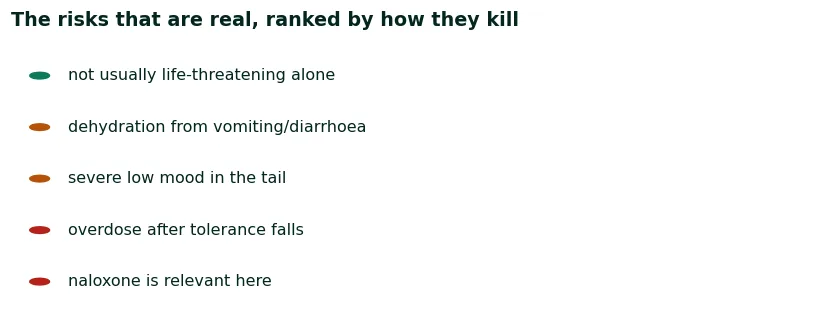
If fluids will not stay down, if mood drops toward self-harm, if breathing seems affected, or if alcohol or benzodiazepines are also involved. Withdrawal from those two can kill in a way opioid withdrawal alone does not, and their presence moves you from a taper conversation to a medical one.
What this page cannot tell you
Much of what circulates comes from forums: 7oh withdrawal reddit threads outnumber clinical sources, and they are worth reading for recognition rather than for plans, because people whose stopping went smoothly rarely post. It cannot give you an hour-by-hour curve, because that measurement has never been published for this substance. It cannot give you a taper schedule or a dose equivalence, for reasons stated above. It cannot tell you your state’s law today with confidence, because that line is moving month to month. What it can do is tell you what the 200 papers actually contain, what the two published cases show, and what the Federal Register said on the day this page was written.
Where this sits in the system of care
Addiction treatment is organised into levels of care, and clinicians choose between them using the ASAM criteria (six dimensions covering withdrawal risk, medical and psychiatric conditions, readiness, relapse risk and, decisively, the environment you return to. Facilities are licensed by the state and many hold additional accreditation from bodies such as the Joint Commission or CARF; that status is worth confirming for any specific programme. Percentages below are our count of how many facilities in the federal directory report offering each level of care.
- Detox19.5% of facilitiesmedical withdrawal management, 3–7 daysDetox vs rehab
- Residential21.4% of facilitieslive on site, 24-hour staffingInpatient vs outpatient
- PHP20–30 structured hours a week, sleep at homePHP vs IOP
- IOP9–19 hours a week, usually compatible with workPHP vs IOP
- Standard outpatient85.4% of facilities1–8 hours a week, the maintenance levelMutual aid options
“Remaining in treatment for an adequate period of time is critical.”
Programmes for specific groups
Facilities also report dedicated programming, and the coverage is wider than most people expect, worth asking about before assuming a programme will not fit. From our count: 42.7% run programmes for adolescents, 39.2% for veterans, 38% for pregnant and postpartum women, and 25% provide services in Spanish. Medication for opioid use disorder is available at 59.2% (buprenorphine) and 13.7% (methadone).
Cost and coverage vary by level: residential care is the tier insurers scrutinise most and almost always requires prior authorisation before admission. See what your plan covers and how to pay without insurance. Family involvement is a standard part of most programmes, and aftercare planning ( step-down to a lower level, sober living, relapse prevention) should be discussed before admission, not at discharge. If a mental health condition is also present, ask specifically whether the programme is staffed for co-occurring disorders: 69.5% of facilities in the directory report treating them, but that is a self-reported field worth confirming.


Common questions
What is 7-OH, exactly?
7-hydroxymitragynine, a kratom alkaloid that the leaf carries only in traces. The tablets, powders and shots sold under the name are made by oxidising mitragynine, so the product is semi-synthetic even when the label says kratom. A 2025 Pharmaceutical Biology review describes these products as chemically distinct from botanical kratom.
How long does 7-OH withdrawal last?
No measured timeline exists for 7-OH specifically; our PubMed count found 200 papers and not one cohort followed through withdrawal. The pattern follows short-acting opioids: onset within hours, the acute stretch across the first days, and a tail of poor sleep and low mood for weeks. Any hour-by-hour chart is borrowed from other opioids.
Is 7-OH stronger than morphine?
In binding and potency assays, yes: the 2025 review describes nanomolar affinity and potency often exceeding morphine. That is a laboratory statement, not a conversion table, and no defensible milligram equivalence exists between a 7-OH product and any prescription opioid.
Is 7-OH banned right now?
Not as of 14 October 2026. The July notice of intent was withdrawn and replaced by a new notice published 14 October 2026, covering 7-OH and mitragynine pseudoindoxyl above a threshold; the order itself cannot take effect before roughly mid-November. Three related compounds, MGM-15, MGM-16 and mitragynine pseudoindoxyl, are separately in Schedule I until August 2028, and several states have their own rules.
When does the federal ban actually start?
It has not. The new notice of intent was published 14 October 2026, and a temporary order can follow no sooner than about 30 days after publication, so mid-November 2026 at the earliest. The 2016 precedent, where a similar notice was withdrawn without an order, is the reason to treat any specific date as provisional.
How fast does dependence on 7-OH develop?
Faster than people expect from a shop product. The published case in the Journal of Addiction Medicine documents withdrawal after four days at 20 mg three times daily in a person switching from leaf kratom. Days, not months.
Does buprenorphine help with 7-OH withdrawal?
There is now a published case saying it can: Held and Varicat, 2026, report 7-OH withdrawal treated with buprenorphine-naloxone. One case is not an approval, and the federal institute still lists no approved therapy, but the conversation with a prescriber is now about a documented case. Timing matters: starting buprenorphine too soon after a full agonist can precipitate severe withdrawal.
Can you overdose on 7-OH?
The laboratory answer is yes in the opioid sense: 7-OH causes respiratory depression in animal models, reversed by naloxone, unlike leaf kratom which generally does not show that profile. A product sold as a supplement warrants the same overdose precaution as an opioid, including naloxone in the house.
Does 7-OH show up on a drug test?
Not on standard workplace panels, which screen a defined list that does not include kratom alkaloids. Specific assays for mitragynine metabolites exist in clinical and forensic settings, so it is not normally tested for rather than undetectable.
Where do I get treatment for 7-OH dependence?
Through the opioid route. The federal treatment locator has no category for kratom or 7-OH, so ask for a provider who treats opioid use disorder and say plainly what you have been taking. That translation is pharmacologically accurate, and the 2026 buprenorphine case shows the route works in practice.
Is 7-OH the same as kratom extract?
No. An extract concentrates what the leaf already contains; a 7-OH product adds an alkaloid the leaf barely contains, made by an oxidation step. Both are stronger than plain leaf, they are not equivalent, and the packaging often does not say which one you have.
Sources
- Our PubMed measurement, 14 October 2026 (E-utilities esearch): "7-hydroxymitragynine" = 200; with withdrawal/dependence = 86; case reports[pt] = 17; randomized controlled trial[pt] = 2; 2024-2026 = 91; kratom = 1,189
- Alsbrook S, Pro G, Koturbash I. "From kratom to 7-hydroxymitragynine", Pharmaceutical Biology 2025;63(1):896-911 (PubMed 41275505)
- Smith KE et al., concurrent kratom and 7-OH product use, Journal of Addiction Medicine, 31 October 2025 (PubMed 41177541)
- Held JT, Varicat FP. "7-Hydroxymitragynine Withdrawal Treated With Buprenorphine-Naloxone", Primary Care Companion for CNS Disorders 2026;28(4):26cr04232
- NIDA: Kratom research topic page
- DEA temporary scheduling order for mitragynine pseudoindoxyl, MGM-15, MGM-16, Federal Register, 26 August 2026 (doc. 2026-17429)
- DEA notice of intent on 7-OH above a threshold, Federal Register, 6 July 2026 (doc. 2026-13580; withdrawn October 2026)
- Congressional Research Service, Legal Sidebar LSB11457: Temporary Control of 7-Hydroxymitragynine and Related Substances
- SAMHSA FindTreatment.gov, the public treatment locator
Compare levels of care
Check what your plan covers
How this page was made
- Who wrote it:
- the Westbrook Recovery editorial team : researchers and writers, not clinicians. No doctor has reviewed this page, and we do not claim otherwise. What that means in practice: we report what public clinical sources say and show you where to read them, rather than offering a clinical opinion of our own.
- Checked against:
- 9 primary sources listed above: federal agency material and published clinical criteria. Where a figure varies by state, plan or facility, we say so instead of publishing a number that looks authoritative and is not.
- Original analysis:
- the facility proportions on this page are our own count of SAMHSA’s public directory. The full method is documented , including what we count, what we deliberately do not publish, and an error the approach caught. You can repeat the pull and check the numbers.
- Last reviewed:
- . This date changes when the content is actually re-checked, not automatically on every visit.
- What this page is not:
- a medical recommendation, a diagnosis, or a referral. Decisions about levels of care and medication belong with a clinician who knows your history. We do not operate facilities, take placement fees, or receive payment for sending anyone anywhere.
Related on this site
- Opioid withdrawal timelinethe syndrome this one follows, measured where it has actually been measured
- Suboxone withdrawal timelinethe induction-timing rules from the buprenorphine label, in detail
- What happens in rehabwhat the opioid-route treatment actually consists of, day by day
- Does insurance cover detoxthe coverage side of getting medical help with withdrawal
More guides
- Free Rehab for VeteransVeterans get free addiction treatment three ways: VA care, Vet Centers without enrollment, COMPACT Act crisis care. How each door works.
- Average Cost of RehabWe read the top-ranking pages and their quoted 30-day prices disagree by 11x. Real cost drivers by level of care, and how to get your actual number.
- Addiction Treatment for Pregnant WomenTreatment in pregnancy is safer than untreated addiction: recommended medications, supervised detox, integrated prenatal care, priority rules.
- Rehab for Women With ChildrenRehab when you have children: programs where kids stay, childcare during treatment, custody, and funded routes for mothers.
- Does Medicaid Cover Drug Rehab?Yes, in every state, but the details differ by state. What Medicaid covers at each level, the IMD wrinkle, and our per-state counts.
- Rehab That Allows Cell PhonesWhich rehabs allow cell phones: the spectrum from lockbox to open access, who allows what, and how to verify a policy in writing first.
- Alcohol Rehab for SeniorsAlcohol treatment for older adults: slower, safer detox, medication and fall risks, what Medicare covers, and finding a program that fits.
- Long-Term Drug RehabLong-term rehab is 90 days to a year: therapeutic communities, extended care, ministry programs. Who needs it, what it costs, the research, vetting.
- How to Stage an InterventionHow to stage an intervention that ends in treatment: the team, the letters, rehearsal, the bed arranged first, and what to do if the answer is no.
- Drug Rehab for CouplesCan couples go to rehab together? The two models, the approach with real trial evidence, costs for two, and how to vet a program.
- Executive Drug RehabExecutive and luxury rehab: what the premium buys, what insurance covers, privacy under 42 CFR Part 2, and how to verify clinical quality behind amenities.
- Does Insurance Cover Detox?Yes, almost always: detox is the most defensible level of care to insurers. Prior auth, Medicaid and Medicare rules, and what our audit of 5 insurers found.
- Free Drug RehabFree addiction treatment exists: state-funded programs, Medicaid, sliding scales and charity. What free covers and how to find real care near you.
- Christian Drug RehabChristian drug rehab: licensed programs with a faith track versus ministries, what treatment includes, costs, and how to verify a program before enrolling.
- How Long Is Rehab?Detox takes 3 to 7 days, residential rehab 30 to 90 days, outpatient care 8 to 12 weeks. What decides your stay, measured against 10,233 facilities.
- How to Get Someone Into Rehab When the First Answer Is NoMost adults with addiction do not think they need treatment. Plan for the no: ready the bed first, pick the hour, make one concrete offer.
- How to Pay for Rehab Without Insurance: Which Door Your Income OpensNo insurance does not mean no treatment. The 2026 income lines in dollars: Medicaid, the subsidy cliff, state-funded care, sliding scales.
- Rehab Rules in 2026: What Ten Real Handbooks Actually SayWe read ten real patient handbooks and counted: phones restricted at nine of ten, a 30-day blackout at one. What the rules say, and what to ask.
- Suboxone Withdrawal Timeline in 2026: What the Studies MeasuredHow long Suboxone withdrawal lasts, why it starts late, and what the taper trials measured: the timeline from evidence, not folklore.
- Meth Withdrawal Timeline: The Shape, the Source, and What the Top Pages Get WrongWorst inside the first day, better across the week, a long low tail. We checked the top pages against the one study behind their numbers.
- Cocaine Withdrawal Timeline: The Crash, the Weeks After, and What HelpsWhat cocaine withdrawal feels like hour by hour and week by week, why no approved medicine exists after 166 trials, and the treatment 149 trials support.
- Opioid Withdrawal Timeline: The Clock, the Peak, and How It Is Actually MeasuredOnset about 12 hours after short-acting opioids, 30 after methadone; worst days two to three. Plus the scale clinicians use, read from the source.
- Relapse Warning Signs in 2026: The Signs and the Measured Map Behind ThemThe measured map behind relapse warning signs: what precedes relapse across three substances, from the 1985 table and its 2026 replication.
- Rehab for Professionals: The Monitored Path, MeasuredLicensed professionals are treated inside monitored programs with the field's best documented outcomes. Who runs them, with the FAA numbers.
- What Happens in Rehab: The Day, the Week, the MonthAdmission day is paperwork, not therapy. Most of the rest is group work. An honest account of the schedule, the therapies by name and the emotional arc.
- Court-Ordered Rehab: How It Works, What It Costs, Whether It WorksWhat court-ordered rehab actually means, how drug courts work phase by phase, what 337 studies and 4,000 courts show, and what happens if you fail.
- Sober Living Rules in 2026: The House Rules, and the Network Behind ThemThe house rules people actually live under, plus our own count of the largest network: every Oxford House in the live directory, by state, beds and openings.
- How Long Suboxone Stays in Your System: The Two Clocks, MeasuredBuprenorphine half-life 24-42 hours; urine finds it about a week after daily use, hair for months. What the label and 488 studies say.
Weighing levels of care? See PHP vs IOP and what your insurance covers.
This page is information, not medical or legal advice. Laws on commitment and treatment differ by state. If you are in crisis, call or text 988 in the US, or reach the SAMHSA National Helpline at 1-800-662-4357 — free, confidential, 24/7.