Cocaine Withdrawal Timeline: The Crash, the Weeks After, and What Helps
Last updated
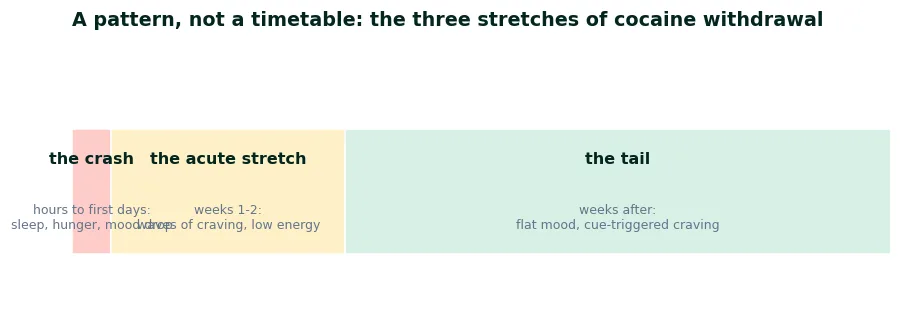
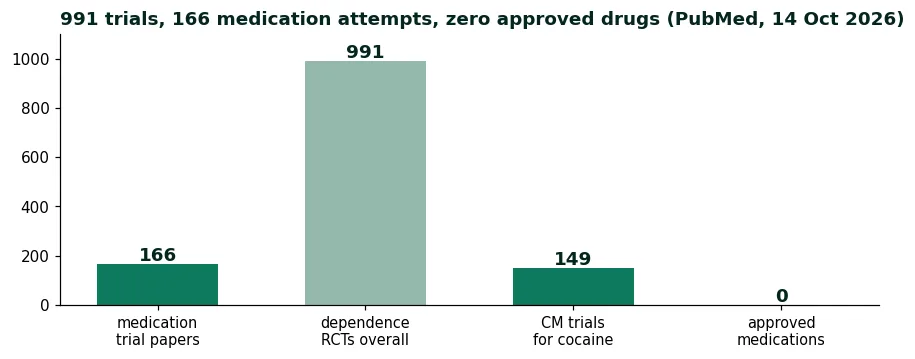
The comedown people describe anecdotally, coming down from cocaine into a flat, hungry, exhausted day, is the same event the clinical literature calls withdrawal. Cocaine withdrawal starts fast and is invisible from the outside. Within hours of the last use comes the crash: exhaustion, sleep that overshoots, hunger that returns all at once, and a mood drop that can be severe. The acute stretch runs about one to two weeks, and a tail of low mood, poor sleep and craving can follow for weeks after that. There is no medication approved for it anywhere in the world, and that is not for lack of trying: we counted 166 publications reporting medication trials for cocaine withdrawal or dependence, and 991 randomised trials for cocaine dependence overall. The treatment with the deepest trial record is not a pill at all.
The short version
- The crash starts within hours — stimulant withdrawal begins on the same day for most people: sleep, hunger and a mood drop, not vomiting or shaking
- There are no visible physical signs — unlike opioid or alcohol withdrawal, so people around you may not register that anything is happening
- 166 medication trials, zero approvals — our PubMed count, 14 October 2026: 166 papers report medication trials here; not one produced an approved drug
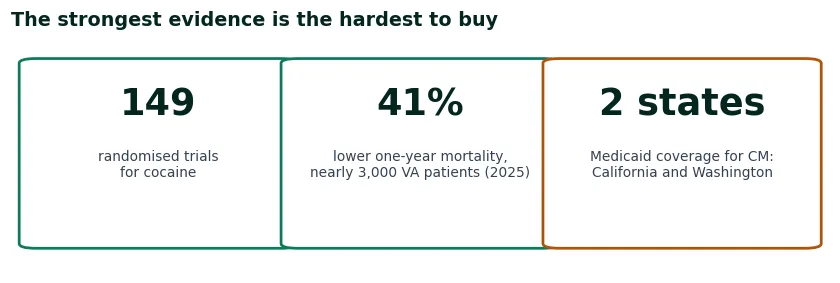
- The best evidence is behavioural — 149 randomised trials back contingency management, and a 2025 VA study of nearly 3,000 patients linked it to 41% lower one-year mortality
- The danger sits after the acute phase — overdose risk rises when tolerance falls, and cocaine supplies are increasingly contaminated with fentanyl
- Depression in withdrawal can be dangerous — a mood crash with thoughts of self-harm is a medical event, not a willpower problem
We counted the trials before writing the timeline
Our analysisCocaine withdrawal advice is full of confident numbers, so we measured the evidence record itself before repeating any of them. The count below is from PubMed on 14 October 2026, and it is the reason this page says what it says about medication.
- 2,784
- publications on cocaine withdrawal
- PubMed esearch, 14 October 2026; verbatim queries in the sources list
- 991
- randomised trials in cocaine dependence
- the effort is enormous; the pharmacological return is not
- 166
- papers reporting medication trials
- decades of candidates, from antidepressants to stimulant replacement
- 149
- randomised trials of contingency management for cocaine
- the deepest evidence in the field is behavioural, not pharmaceutical
- 41%
- lower one-year mortality with CM
- nearly 3,000 VA patients with stimulant use disorder, Coughlin et al. 2025, Am J Psychiatry
- 0
- approved medications, by anyone
- not FDA, not any regulator. Pages implying otherwise are ahead of the evidence
How we got this: we counted the cocaine withdrawal and treatment-trial record directly on PubMed's public E-utilities on 14 October 2026, queries printed verbatim in this page's record, and read the 2025 American Journal of Psychiatry analysis of contingency management in the VHA.
What these numbers cannot tell you: trial counts measure research effort, not your outcome; and a count of randomized trials is not a promise about any single person.
What cocaine withdrawal actually is
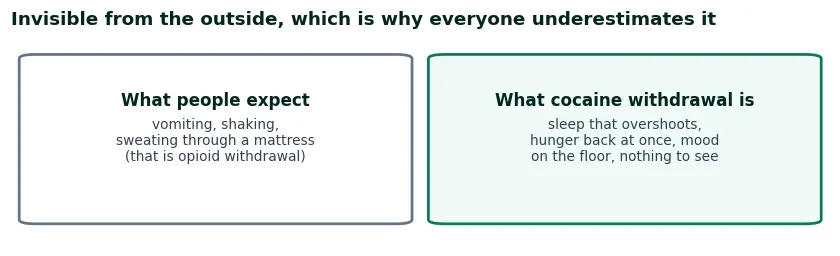
Withdrawal from cocaine is a real, measurable syndrome, and it looks nothing like the film version of withdrawal. There is no vomiting, no shaking, no visible storm. What arrives instead is a crash: profound tiredness, sleeping far longer than usual, hunger returning all at once, and a mood drop that ranges from flat to genuinely dangerous. Because nothing shows on the outside, people underestimate it, and so do the people around them. That underestimation is the first thing worth correcting.
Why it is easy to miss
Opioid withdrawal announces itself through the body. Cocaine withdrawal lives in sleep, appetite, mood and concentration, which read as laziness or a bad week to anyone watching. The person inside it often concludes the same thing and pushes through alone, which is how the mood part of the crash becomes the dangerous part.
Crack and powder are the same syndrome
Crack cocaine and powder cocaine are the same drug in different forms, and the withdrawal is one syndrome. What differs is the intensity of the cycle while using, since smoking delivers the drug faster and the crashes between sessions come harder. Everything on this page applies to both.
The timeline: crash, acute stretch, tail
No single study owns this timeline the way one 2005 study owns the methamphetamine one, and the clinical reviews describe a consistent pattern rather than a universal schedule. Read it as a pattern: the timing shifts with how much, how often, how long, and what else is in the picture.
The crash: hours to the first days
Within hours of the last use: exhaustion, a need to sleep that can run past a day, and hunger returning sharply. Mood drops in the same window, from flatness and irritability to, in heavier use, agitation and thoughts of self-harm. Craving often peaks early here, and the sleep is heavy rather than restorative.
The acute stretch: the first one to two weeks
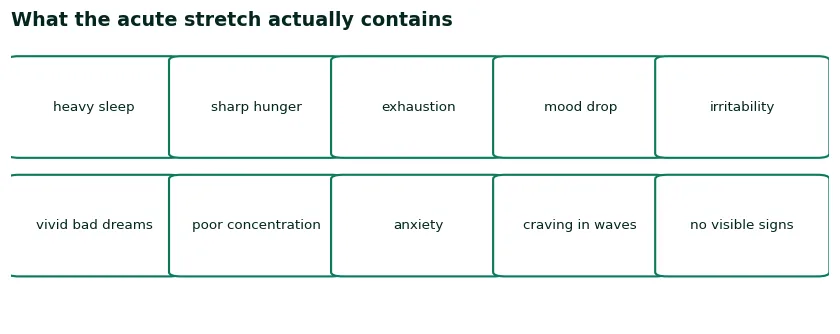
Sleep gradually normalises in length but not in quality, with vivid, unpleasant dreams common. Concentration and energy stay low, irritability and anxiety run through the days, and craving comes in waves rather than fading steadily. Most people describe the second week as easier than the first and harder than they expected.
The tail: weeks of flatness
After the acute stretch, the picture shifts from body to mood: blunted pleasure, poor sleep, low motivation, and craving that arrives with cues rather than on a schedule. This is the stretch where people conclude they feel worse sober than they did using, and where the warning signs of relapse are the practical read.
What 2,784 papers and zero approvals mean
We counted the record before writing this page, because the gap between effort and result here is itself the story. On 14 October 2026 PubMed held 2,784 publications mentioning cocaine withdrawal, 439 of them since 2020. Buried in the dependence record are 991 randomised trials, and 166 papers reporting medication trials aimed at withdrawal or dependence. The number of medications approved for cocaine use disorder, by the FDA or anyone else, is zero.
| Slice of the record | Publications |
|---|---|
| Mentioning cocaine withdrawal | 2,784 |
| Of those, published 2020-2026 | 439 |
| Reviews of the subject | 482 |
| Case reports | 86 |
| Randomised trials in cocaine dependence | 991 |
| Papers reporting a medication trial | 166 |
| Contingency management trials for cocaine | 149 |
| Medications approved as a result | 0 |
Mentioning cocaine withdrawal
2,784
Of those, published 2020-2026
439
Reviews of the subject
482
Case reports
86
Randomised trials in cocaine dependence
991
Papers reporting a medication trial
166
Contingency management trials for cocaine
149
Medications approved as a result
0
This is not a gap in the search
When a condition has 991 randomised trials and no approved medication, the honest conclusion is that the problem is hard, not that nobody looked. Decades of candidates, from antidepressants to anti-epileptics to stimulant replacement, produced signal too weak or too inconsistent to approve. The FDA published its first draft guidance for stimulant trial design in 2023, which tells you the regulator expects this to keep running.
What the pipeline looks like now
Active trials continue: extended-release naltrexone plus bupropion was recruiting for phase 3 with completion expected in late 2026, and a phase 3 trial of mirtazapine for methamphetamine reported a modest benefit in 2026. Conditional, low-certainty options exist off-label, topiramate and modafinil among them, under the ASAM/AAAP guideline. None of this is a medicine you can ask for by name at a clinic yet, and pages implying otherwise are ahead of the evidence.
Why we put the count on the page
Because it disciplines the page. Where the record is strong we say so; where it is thin we mark it thin. The record on what works behaviourally is genuinely strong, which is where the next section goes.
The most-tested treatment is the one least offered
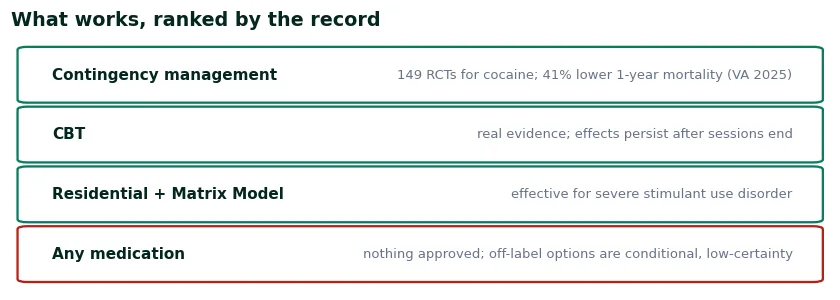
The intervention with the deepest evidence in all of addiction medicine is not a medicine. Contingency management, structured, escalating rewards for verified abstinence, carries 149 randomised trials for cocaine alone, and the ASAM/AAAP guideline recommends it as a primary component of stimulant use disorder treatment on high-certainty evidence. It is also the option you are least likely to be offered.
What the evidence now includes
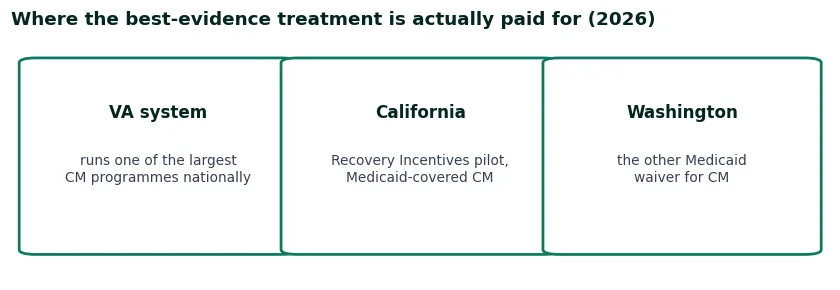
Beyond the trial record, a 2025 study of nearly 3,000 Veterans Health Administration patients with stimulant use disorder found that those who received contingency management were 41% less likely to die within a year than those who did not. That is a mortality finding, not a satisfaction score, and it is part of why the VA runs one of the largest CM programmes in the country.
Why you may not be offered it
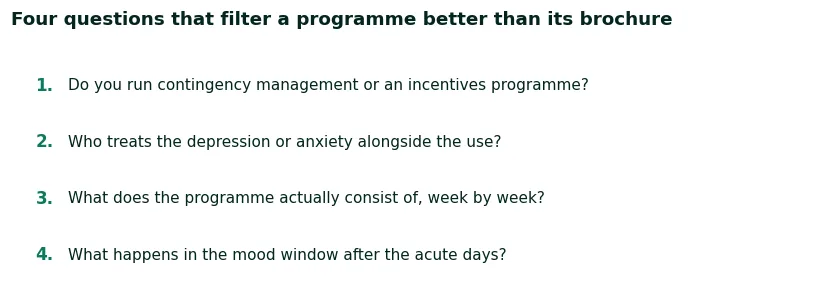
Funding and billing rules, mostly. Medicaid coverage for contingency management existed only in California and Washington as of 2026, with California running a dedicated Recovery Incentives pilot, and most private providers never built the programme at all. When you call a programme, ask directly whether they run contingency management or an incentives programme; the answer tells you more than the brochure does.
What else earns its place
Cognitive behavioural therapy has real evidence, with effects that persist after sessions end, and residential programmes using structured models like the Matrix Model remain effective for severe stimulant use disorder. Exercise-based interventions carry smaller but real support. What a programme actually consists of day by day is on the linked page.
The danger is not inside the withdrawal
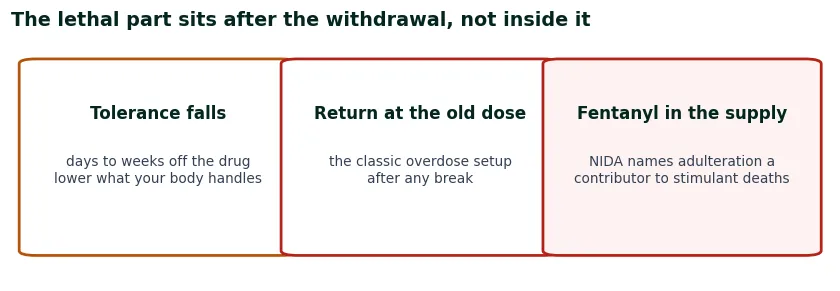
Cocaine withdrawal itself is not considered life-threatening the way untreated alcohol or benzodiazepine withdrawal can be. The lethal risks sit next to it: the mood crash in the crash, and the overdose that follows a return to use after even a short break.
Tolerance falls faster than people think
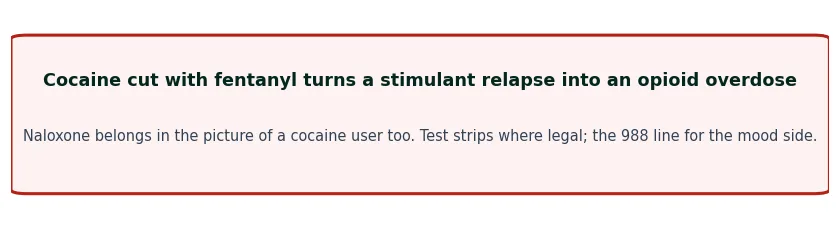
Days to weeks off the drug lower tolerance, and a return at the old dose is the classic overdose setup. NIDA names adulteration with fentanyl as a contributor to stimulant-involved deaths, and the supply problem has grown since: cocaine cut with fentanyl turns a stimulant relapse into an opioid overdose, which is why naloxone belongs in the picture for a cocaine user too.
The mood crash is a medical event when it goes dark
Depression in the acute phase can be severe, and stimulant withdrawal carries a documented suicidality risk. Thoughts of self-harm during the crash are not a character failing and not something to ride out in a dark room: they are the point where this stops being a home event. The 988 lifeline and the SAMHSA helpline are both in the footer of this page for exactly this reason.
When the crash needs a clinician
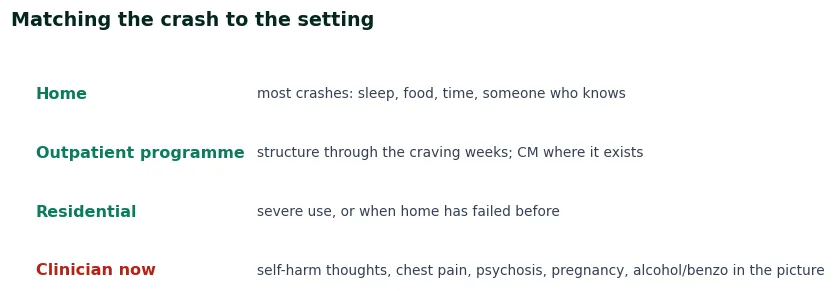
Most cocaine withdrawal is survived at home with sleep, food and time. The exceptions are specific, and they are worth knowing before the crash, because the crash is a bad time to make the call.
The specific exceptions
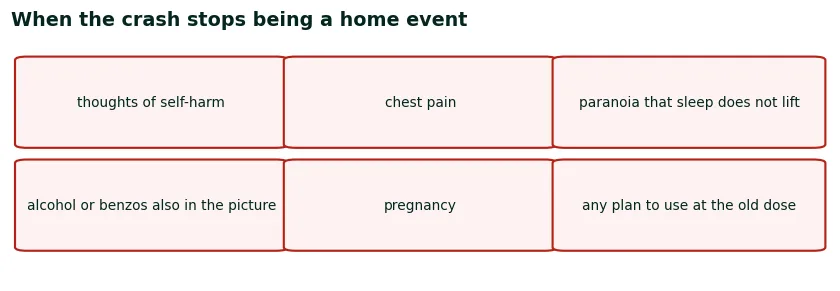
Thoughts of self-harm or suicide. Chest pain, which cocaine can cause on its own. Other substances in the picture, especially alcohol and benzodiazepines, whose withdrawals can kill. Paranoia or psychosis that does not lift with sleep. And pregnancy, which changes the whole plan and belongs in coordinated care, as covered on addiction treatment for pregnant women.
What a clinician adds here
Not a detox drug, because there is not one. What a programme adds is monitoring through the mood window, treatment for the depression or anxiety that cocaine was covering, structure through the cue-driven craving weeks, and, where it exists, contingency management. Whether insurance covers detox levels of care is its own question, answered on the linked page.
What this page cannot tell you
It cannot give you your personal timeline, because the speed of the crash and the length of the tail depend on how much, how often and how long, and no study can answer for your nervous system. It cannot recommend a medication, because none exists to recommend. And it cannot tell you which programme near you runs contingency management, because nobody publishes that list. What it can do is tell you the shape of the next weeks, the size of the evidence record, and the two questions that filter a good programme from a brochure.
Where this sits in the system of care
Addiction treatment is organised into levels of care, and clinicians choose between them using the ASAM criteria (six dimensions covering withdrawal risk, medical and psychiatric conditions, readiness, relapse risk and, decisively, the environment you return to. Facilities are licensed by the state and many hold additional accreditation from bodies such as the Joint Commission or CARF; that status is worth confirming for any specific programme. Percentages below are our count of how many facilities in the federal directory report offering each level of care.
- Detox19.5% of facilitiesmedical withdrawal management, 3–7 daysDetox vs rehab
- Residential21.4% of facilitieslive on site, 24-hour staffingInpatient vs outpatient
- PHP20–30 structured hours a week, sleep at homePHP vs IOP
- IOP9–19 hours a week, usually compatible with workPHP vs IOP
- Standard outpatient85.4% of facilities1–8 hours a week, the maintenance levelMutual aid options
“Remaining in treatment for an adequate period of time is critical.”
Programmes for specific groups
Facilities also report dedicated programming, and the coverage is wider than most people expect, worth asking about before assuming a programme will not fit. From our count: 42.7% run programmes for adolescents, 39.2% for veterans, 38% for pregnant and postpartum women, and 25% provide services in Spanish. Medication for opioid use disorder is available at 59.2% (buprenorphine) and 13.7% (methadone).
Cost and coverage vary by level: residential care is the tier insurers scrutinise most and almost always requires prior authorisation before admission. See what your plan covers and how to pay without insurance. Family involvement is a standard part of most programmes, and aftercare planning ( step-down to a lower level, sober living, relapse prevention) should be discussed before admission, not at discharge. If a mental health condition is also present, ask specifically whether the programme is staffed for co-occurring disorders: 69.5% of facilities in the directory report treating them, but that is a self-reported field worth confirming.


Common questions
How long does cocaine withdrawal last?
The crash starts within hours and the acute phase runs about one to two weeks, with the hardest stretch early. A tail of low mood, vivid dreams, poor sleep and cue-triggered craving can follow for weeks. The exact shape shifts with how much, how often and how long you used; no study can give you your personal schedule.
What does cocaine withdrawal feel like?
Nothing like the film version. Heavy sleep, sharp hunger, exhaustion, and a mood drop that runs from flat to dangerous, with craving in waves. There are no visible physical signs, which is why the people around you may not register it, and why the mood part gets underestimated.
Is cocaine withdrawal dangerous?
The withdrawal itself is not life-threatening the way alcohol or benzodiazepine withdrawal can be. The real dangers are the depression in the acute phase, which can reach suicidality, and the overdose risk of returning to use after tolerance has fallen, now compounded by fentanyl in the cocaine supply.
Is there a medication for cocaine withdrawal?
No. We counted 166 publications reporting medication trials and 991 randomised trials in cocaine dependence on 14 October 2026; no medication is approved for this, by the FDA or any other regulator. Off-label options with conditional, low-certainty evidence exist under specialist care, and the treatment with the strongest evidence is behavioural: contingency management.
What is contingency management?
Structured, escalating rewards for verified abstinence, usually negative drug tests on a schedule. It carries 149 randomised trials for cocaine, a strong recommendation in the ASAM/AAAP guideline, and a 2025 VA study linking it to 41% lower one-year mortality. The barrier is availability, not evidence: ask programmes directly whether they run it.
Do I need detox for cocaine?
Usually not in the medical sense, because the withdrawal is not physically dangerous the way alcohol withdrawal is. What a programme adds is monitoring through the mood window, treatment for what cocaine was covering, and structure through the craving weeks. Exceptions that change that: self-harm thoughts, chest pain, psychosis, pregnancy, or alcohol and benzodiazepines in the picture.
Is crack withdrawal different from cocaine withdrawal?
No. Crack is cocaine; the withdrawal syndrome is the same. What differs is the cycle while using, because smoking delivers the drug faster and crashes come harder between sessions.
Can you sleep too much in cocaine withdrawal?
The crash typically brings very long sleep in the first days, and that overshoot is a known feature rather than a warning sign. The warning signs are different: self-harm thoughts, chest pain, paranoia that does not lift, and any plan to return to use at the old dose.
Why am I so hungry in cocaine withdrawal?
Because cocaine suppresses appetite and the withdrawal returns it with interest. The acute phase characteristically includes increased eating alongside increased sleeping, which surprises people expecting the opioid picture of vomiting and shaking.
When does craving for cocaine stop?
Craving peaks early in the crash, eases across the acute weeks, and then keeps arriving in waves triggered by cues: places, people, paydays. That cue-driven craving is why the weeks after the acute phase are where relapse actually happens, and where support structure earns its keep.
Can you die from cocaine withdrawal?
Not from the withdrawal itself in the way alcohol withdrawal kills. The mortality risk sits next to it: suicide in the mood crash and overdose on return to use, especially with fentanyl now common in cocaine supplies. A 2025 VA study found a behavioural treatment cut one-year mortality by 41%, which is the number to hold onto here.
Sources
- Our PubMed measurement, 14 October 2026 (E-utilities esearch): "cocaine withdrawal" = 2,784; 2020-2026 = 439; review[pt] = 482; case reports[pt] = 86; cocaine dependence RCTs = 991; medication-trial papers = 166; contingency management cocaine RCTs = 149
- MedlinePlus Medical Encyclopedia: Cocaine withdrawal (NIH/NLM)
- Coughlin LN et al., contingency management and one-year mortality in stimulant use disorder, American Journal of Psychiatry 2025;182(11)
- ASAM/AAAP Clinical Practice Guideline on the Management of Stimulant Use Disorder, J Addict Med 2024;18(1S Suppl 1) (PubMed 38669101)
- NIDA: Cocaine, including fentanyl adulteration as a contributor to stimulant-involved deaths
- NCHS Data Brief No. 522: Drug Overdose Deaths in the United States, 2003-2023
- SAMHSA FindTreatment.gov, the public treatment locator
- SAMHSA National Helpline: free, confidential, 24/7
Compare levels of care
Check what your plan covers
How this page was made
- Who wrote it:
- the Westbrook Recovery editorial team : researchers and writers, not clinicians. No doctor has reviewed this page, and we do not claim otherwise. What that means in practice: we report what public clinical sources say and show you where to read them, rather than offering a clinical opinion of our own.
- Checked against:
- 8 primary sources listed above: federal agency material and published clinical criteria. Where a figure varies by state, plan or facility, we say so instead of publishing a number that looks authoritative and is not.
- Original analysis:
- the facility proportions on this page are our own count of SAMHSA’s public directory. The full method is documented , including what we count, what we deliberately do not publish, and an error the approach caught. You can repeat the pull and check the numbers.
- Last reviewed:
- . This date changes when the content is actually re-checked, not automatically on every visit.
- What this page is not:
- a medical recommendation, a diagnosis, or a referral. Decisions about levels of care and medication belong with a clinician who knows your history. We do not operate facilities, take placement fees, or receive payment for sending anyone anywhere.
Related on this site
- Meth withdrawal timelinethe other stimulant, where one 2005 study owns the timeline
- What happens in rehabwhat structured treatment actually consists of, day by day
- Free drug rehabthe options when cost is the barrier to the programme
- Does insurance cover detoxthe coverage side of the withdrawal week
More guides
- Free Rehab for VeteransVeterans get free addiction treatment three ways: VA care, Vet Centers without enrollment, COMPACT Act crisis care. How each door works.
- Average Cost of RehabWe read the top-ranking pages and their quoted 30-day prices disagree by 11x. Real cost drivers by level of care, and how to get your actual number.
- Addiction Treatment for Pregnant WomenTreatment in pregnancy is safer than untreated addiction: recommended medications, supervised detox, integrated prenatal care, priority rules.
- Rehab for Women With ChildrenRehab when you have children: programs where kids stay, childcare during treatment, custody, and funded routes for mothers.
- Does Medicaid Cover Drug Rehab?Yes, in every state, but the details differ by state. What Medicaid covers at each level, the IMD wrinkle, and our per-state counts.
- Rehab That Allows Cell PhonesWhich rehabs allow cell phones: the spectrum from lockbox to open access, who allows what, and how to verify a policy in writing first.
- Alcohol Rehab for SeniorsAlcohol treatment for older adults: slower, safer detox, medication and fall risks, what Medicare covers, and finding a program that fits.
- Long-Term Drug RehabLong-term rehab is 90 days to a year: therapeutic communities, extended care, ministry programs. Who needs it, what it costs, the research, vetting.
- How to Stage an InterventionHow to stage an intervention that ends in treatment: the team, the letters, rehearsal, the bed arranged first, and what to do if the answer is no.
- Drug Rehab for CouplesCan couples go to rehab together? The two models, the approach with real trial evidence, costs for two, and how to vet a program.
- Executive Drug RehabExecutive and luxury rehab: what the premium buys, what insurance covers, privacy under 42 CFR Part 2, and how to verify clinical quality behind amenities.
- Does Insurance Cover Detox?Yes, almost always: detox is the most defensible level of care to insurers. Prior auth, Medicaid and Medicare rules, and what our audit of 5 insurers found.
- Free Drug RehabFree addiction treatment exists: state-funded programs, Medicaid, sliding scales and charity. What free covers and how to find real care near you.
- Christian Drug RehabChristian drug rehab: licensed programs with a faith track versus ministries, what treatment includes, costs, and how to verify a program before enrolling.
- How Long Is Rehab?Detox takes 3 to 7 days, residential rehab 30 to 90 days, outpatient care 8 to 12 weeks. What decides your stay, measured against 10,233 facilities.
- How to Get Someone Into Rehab When the First Answer Is NoMost adults with addiction do not think they need treatment. Plan for the no: ready the bed first, pick the hour, make one concrete offer.
- How to Pay for Rehab Without Insurance: Which Door Your Income OpensNo insurance does not mean no treatment. The 2026 income lines in dollars: Medicaid, the subsidy cliff, state-funded care, sliding scales.
- Rehab Rules in 2026: What Ten Real Handbooks Actually SayWe read ten real patient handbooks and counted: phones restricted at nine of ten, a 30-day blackout at one. What the rules say, and what to ask.
- Suboxone Withdrawal Timeline in 2026: What the Studies MeasuredHow long Suboxone withdrawal lasts, why it starts late, and what the taper trials measured: the timeline from evidence, not folklore.
- 7-OH Withdrawal Timeline: What the Record Shows, Not the ForumsWhat 7-hydroxymitragynine withdrawal looks like, what the 200 PubMed papers actually measure, and where the federal ban stood on 14 October 2026.
- Meth Withdrawal Timeline: The Shape, the Source, and What the Top Pages Get WrongWorst inside the first day, better across the week, a long low tail. We checked the top pages against the one study behind their numbers.
- Opioid Withdrawal Timeline: The Clock, the Peak, and How It Is Actually MeasuredOnset about 12 hours after short-acting opioids, 30 after methadone; worst days two to three. Plus the scale clinicians use, read from the source.
- Relapse Warning Signs in 2026: The Signs and the Measured Map Behind ThemThe measured map behind relapse warning signs: what precedes relapse across three substances, from the 1985 table and its 2026 replication.
- Rehab for Professionals: The Monitored Path, MeasuredLicensed professionals are treated inside monitored programs with the field's best documented outcomes. Who runs them, with the FAA numbers.
- What Happens in Rehab: The Day, the Week, the MonthAdmission day is paperwork, not therapy. Most of the rest is group work. An honest account of the schedule, the therapies by name and the emotional arc.
- Court-Ordered Rehab: How It Works, What It Costs, Whether It WorksWhat court-ordered rehab actually means, how drug courts work phase by phase, what 337 studies and 4,000 courts show, and what happens if you fail.
- Sober Living Rules in 2026: The House Rules, and the Network Behind ThemThe house rules people actually live under, plus our own count of the largest network: every Oxford House in the live directory, by state, beds and openings.
- How Long Suboxone Stays in Your System: The Two Clocks, MeasuredBuprenorphine half-life 24-42 hours; urine finds it about a week after daily use, hair for months. What the label and 488 studies say.
Weighing levels of care? See PHP vs IOP and what your insurance covers.
This page is information, not medical or legal advice. Laws on commitment and treatment differ by state. If you are in crisis, call or text 988 in the US, or reach the SAMHSA National Helpline at 1-800-662-4357 — free, confidential, 24/7.